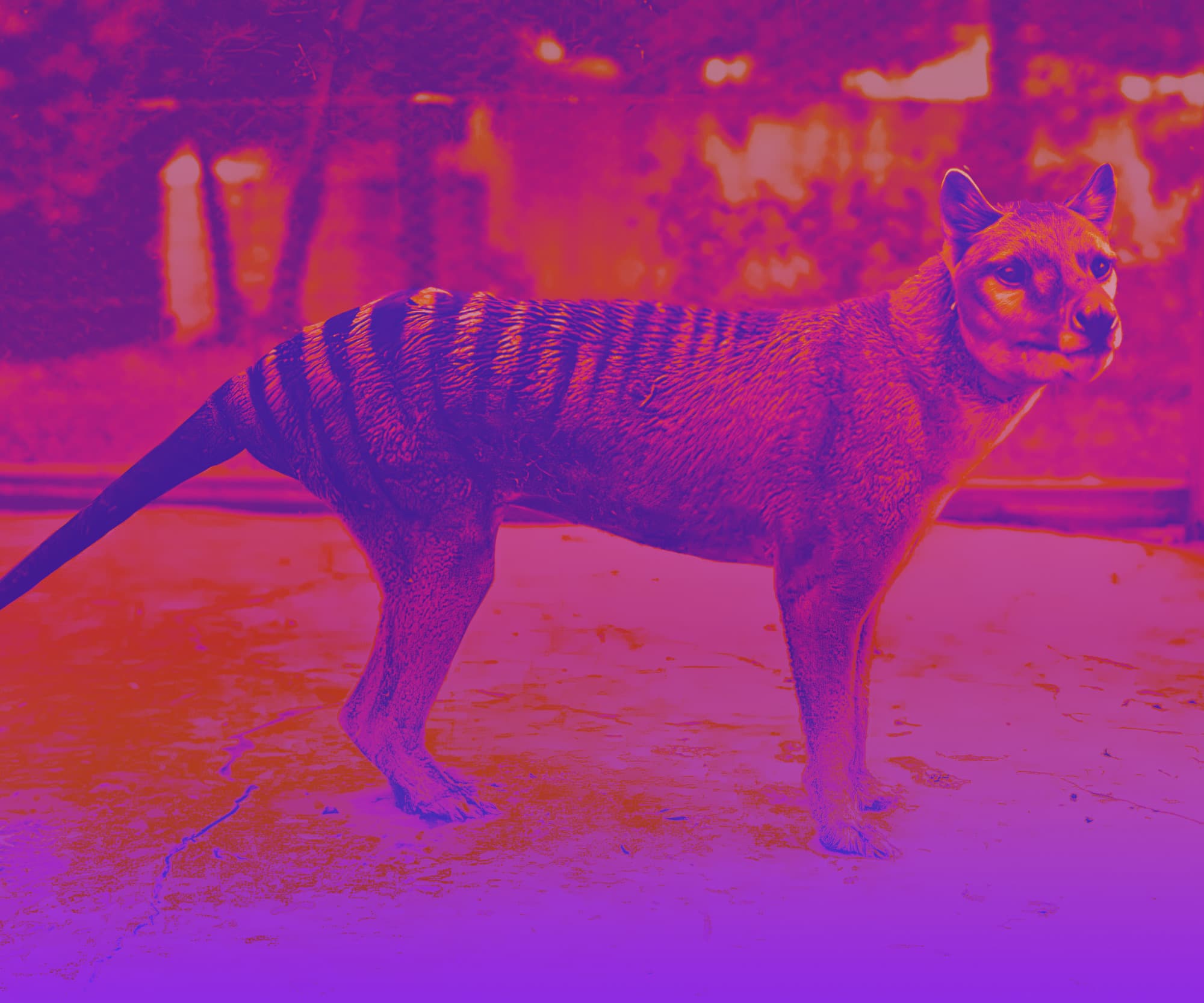
On the night of September 7, 1936, the last known thylacine died alone in an outdoor enclosure at Hobart's Beaumaris Zoo. The keepers had locked him out of his sleeping den as the temperature plunged, and by morning the animal — a male the public would later christen Benjamin — was dead. He was the last of his kind. The species Thylacinus cynocephalus, the largest carnivorous marsupial of the modern world, had walked Tasmania for tens of thousands of years. Its lineage stretched back, through ancestors of the family Thylacinidae, perhaps 25 million years. After Benjamin, there was nothing but a few dozen taxidermied skins, jars of ethanol-preserved organs in museum basements, and a grainy 62-second reel of black-and-white film shot in 1933 — a striped, dog-shaped animal pacing its concrete enclosure, gaping its impossibly wide jaw at the camera, then turning its head to look directly into the lens.
That clip is, for most people, the only thylacine they will ever see. Until, perhaps, now.
In a glass-walled laboratory at the University of Melbourne, marsupial geneticist Andrew Pask runs his hand along a freezer marked with biohazard tape and pulls out a vial. It contains DNA reconstructed from a 108-year-old ethanol-preserved pouch joey. A few floors away, his team is editing the genome of a creature so small it could sit in a teaspoon — a fat-tailed dunnart. The plan is to take that mouse-sized marsupial and turn it, generation by generation, edit by edit, into something that has not breathed Tasmanian air since Benjamin's last cold night. This is the thylacine de-extinction project, the scientific marriage of Pask's TIGRR Lab and Colossal Biosciences. It is, depending on whom you ask, the most rigorous de-extinction program ever attempted — or an elaborate exercise in dressing up a dunnart as a tiger.
What Was the Thylacine?
The thylacine looked like a dog with a kangaroo's pouch and a tiger's paint job. Adults stood roughly 60 centimeters at the shoulder and stretched 100 to 130 centimeters from nose to rump, with another 50 to 65 centimeters of stiff, almost reptilian tail. Males weighed up to about 30 kilograms; females ran a little smaller. Across the lower back and rump ran 13 to 21 dark transverse stripes, fading toward the shoulders. The ears were short and rounded. The skull was the giveaway: long-snouted, cheek teeth like a wolf's, and a jaw that could gape to roughly 80 degrees — wide enough that 19th-century settlers swore the animal could swallow a sheep's head whole.
Despite the canine silhouette, the thylacine was a marsupial. Thylacinus cynocephalus belonged to the order Dasyuromorphia, which today contains the Tasmanian devil (Sarcophilus harrisii), the quolls, the antechinuses and the dunnarts — all small to mid-sized carnivores. The thylacine's resemblance to a wolf or coyote is one of biology's most striking examples of convergent evolution: two lineages, separated for at least 160 million years since the split between marsupial and placental mammals, arriving independently at the same body plan because the same problem (chase, catch, and kill mid-sized prey) has the same solution.
Thylacines once ranged across mainland Australia and New Guinea. Fossil and subfossil evidence — bones, skulls, even mummified carcasses preserved in dry caves — show the animal was a regular presence on the continent until perhaps 3,000 to 3,500 years ago, when it disappeared from the mainland and from New Guinea. Tasmania, separated from the mainland by Bass Strait at the end of the last Ice Age, became its final refuge. There the thylacine reigned as the apex terrestrial predator until Europeans arrived.
Then came the bounty. The Van Diemen's Land Company began paying private hunters for thylacine scalps as early as the 1830s. The Tasmanian colonial government formalized the program in 1888, paying £1 per adult and 10 shillings per pup. Between 1888 and 1909, the government paid out roughly 2,184 bounties, and unofficial kills were certainly higher. Sheep farmers hated the animal. Newspapers ran lurid accounts of "tiger" attacks on flocks. It is unclear how much livestock predation the thylacine was actually responsible for — feral dogs and human poachers took a far greater toll — but the animal was a convenient scapegoat, and a paid one at that.
Why the Thylacine Went Extinct
No single cause killed the thylacine. The bounty did the heavy work: a small island population, a slow-reproducing apex predator, and a relentless economic incentive to shoot every one anyone saw. By the time the bounty was suspended in 1909, sightings had already collapsed. But hunting alone may not have been the whole story.
Habitat conversion played a role. Tasmanian midlands and grasslands were rapidly cleared for sheep grazing through the late 19th century, fragmenting the open-forest habitat the thylacine preferred. Domestic dogs, brought by settlers, almost certainly introduced canine distemper or a related morbillivirus to the dwindling population — Pask and others have argued from museum specimen pathology that an epidemic disease likely accelerated the final collapse in the 1910s and 1920s. On mainland Australia, where the thylacine had vanished long before European contact, the leading hypothesis blames competition with the dingo (a placental dog introduced roughly 4,000 years ago) combined with shifts in Aboriginal hunting and a drying climate.
In Tasmania, by the 1920s, thylacines were already vanishingly rare. A 1928 proposal to make the species a protected fauna was rejected by the colonial parliament. Protection finally came on July 10, 1936 — fifty-nine days before Benjamin died. The last confirmed wild kill had been recorded in 1930. After 1936 there were sightings, of course; there are still sightings today, every year, in northwest Tasmania and the highlands. None has ever been substantiated. The IUCN formally declared the species extinct in 1982, fifty years after the last verified specimen.
That is where the story sat for forty years: a closed file in a museum drawer, a frozen tuft of fur in a jar of methylated spirits, and the 1933 footage looping on documentaries. Then somebody started reading the DNA.
The TIGRR Lab: How Colossal Got Involved
Andrew Pask grew up in Australia and trained as a developmental biologist, with a particular fascination for marsupial reproduction — a system so different from placental mammals that, as he likes to say, it might as well be a separate planet. By the mid-2010s he was running the Pask Lab at the University of Melbourne and quietly building expertise in thylacine genomics. In 2017, with co-author Charles Feigin and others, he published the first reasonably complete thylacine genome assembly in Nature Ecology & Evolution, drawn from a soft-tissue specimen — a pouch joey preserved in ethanol since 1909, then stashed in the Museums Victoria collection.
That paper was a milestone in ancient DNA work. It also planted an idea. If you have a genome, and you have a closely related living relative, and you have CRISPR, then in principle you can edit the relative's cells to express the lost species' traits. Pask began talking publicly about thylacine de-extinction as something that might actually be tried, not just discussed.
In March 2022, philanthropic donations of A$5 million allowed Pask to formally launch the Thylacine Integrated Genetic Restoration Research Lab — TIGRR, pronounced "tiger" — at the University of Melbourne. Five months later, in August 2022, Colossal Biosciences announced a partnership with the TIGRR Lab and added the thylacine to its de-extinction roster alongside the woolly mammoth. The arrangement was initially structured as research funding plus shared scientific direction. By 2024, Colossal expanded the relationship and effectively folded the thylacine work into a unified marsupial program operated jointly with TIGRR, including a dedicated marsupial genomics and reproductive biology team.
The funding boost was transformative. Pre-Colossal, TIGRR was a university lab running on grants. Post-Colossal, it had access to a private de-extinction company's full toolkit: high-throughput sequencing, CRISPR screening platforms, automated cell culture, computational pipelines for variant analysis, and — crucially — a stem cell and reproductive biology team building the kinds of techniques that academic budgets rarely sustain. For Pask, the partnership meant his thylacine work could move from "academic side project that might take 50 years" to "core program with a real shot at producing live animals within the decade."
Reading the Thylacine Genome
To rebuild a species you have to know what it was. Genomics begins with samples, and the thylacine left a useful set behind. Museums around the world hold roughly 750 known thylacine specimens — pelts, skeletons, fluid-preserved organs, even the occasional taxidermy mount with skin still attached. Most are from the period 1850-1930, when collecting was easy and the animal was already on its way out. The most useful specimens for ancient DNA work are those preserved in ethanol or formalin, especially soft-tissue samples kept cool and dark.
The crown jewel is a 108-year-old pouch joey held by Museums Victoria. Stored in ethanol shortly after collection in 1909, it has yielded remarkably intact DNA — fragments long enough, and abundant enough, to assemble a draft genome with confidence. The 2017-2018 reconstruction by Feigin, Pask and colleagues placed the thylacine genome at roughly 3.16 billion base pairs across 14 chromosome pairs (marsupials typically have low chromosome counts), with around 19,000 to 20,000 protein-coding genes — comparable in scope to other dasyurid marsupials.
Colossal has since refined that assembly. Through 2023 and 2024 the company, working with TIGRR and partner labs, sequenced additional museum specimens to fill gaps, correct errors, and build a population-level picture. The team also completed something genuinely unprecedented in October 2023: the recovery of intact RNA from a 130-year-old desiccated thylacine skin held by the Stockholm Natural History Museum. Until that point, RNA — far less stable than DNA — had never been extracted from any extinct species. The recovered transcripts came from skin and skeletal muscle and showed which genes were actively being expressed in those tissues at the moment of death. Knowing what genes are expressed, not just what genes are present, is enormously more useful for guiding edits.
By 2025, Colossal was claiming a "highest-quality ancient genome assembled to date," with sequence coverage across more than 99.9 percent of the genome and complete reconstructions of several entire chromosomes. The data set is the foundation for everything that follows.
The Surrogate Problem: Why a Mouse-Sized Marsupial?
A reconstructed genome is a reference text, not an animal. To produce a living thylacine — or anything close to one — Colossal needs a closely related species whose cells can be edited toward the thylacine genome and whose reproductive biology can carry the resulting embryo to birth. For the woolly mammoth, the obvious surrogate is the Asian elephant: same genus, only six million years of divergence, similar size and gestation. For the thylacine, the closest living relatives are the small carnivorous marsupials — dunnarts, antechinuses, quolls, and the Tasmanian devil. None of them is anywhere near thylacine size.
Colossal chose the fat-tailed dunnart, Sminthopsis crassicaudata. Adults weigh 10 to 20 grams. They are, essentially, mice with pouches. Choosing a mouse-sized animal to gestate a wolf-sized one sounds insane until you remember how marsupials work.
Marsupials give birth to extraordinarily altricial young. A newborn fat-tailed dunnart joey weighs about 0.017 grams — roughly the mass of a grain of rice. A newborn thylacine joey, scaled from related dasyurids, would have weighed only a fraction of a gram. The hard developmental work happens not in utero but inside the pouch, where the joey latches to a teat and effectively continues fetal development for weeks or months while suspended from a milk supply. In the dunnart, in-pouch development takes about 70 days. In larger dasyurids it is longer.
What this means in practice: the surrogate mother only needs to gestate the embryo for roughly 13 days — the brief in-utero phase before pouch attachment. After that, in principle, the joey can be transferred to another pouch (a "wet nurse" approach), or to an artificial pouch with a synthetic milk feed and controlled temperature, humidity and oxygen. So the mismatch between a 15-gram dunnart and what would eventually be a 30-kilogram thylacine becomes much less of a problem than it would be for a placental species. Marsupial reproduction effectively decouples the surrogate's body size from the offspring's adult body size.
This is genuinely unprecedented territory. No one has ever done multi-species marsupial surrogacy in any sustained, repeatable way. Cross-species marsupial embryo transfer has been demonstrated only in a handful of proof-of-concept experiments, mostly between closely related species. Colossal and TIGRR are effectively building a discipline.
The Edit List: Turning a Dunnart Cell into a Thylacine
The dunnart and the thylacine last shared a common ancestor roughly 70 million years ago. That is far deeper than the woolly mammoth's divergence from the Asian elephant (about 6 million years). Across 70 million years of independent evolution, every part of the genome has drifted, even where overall body plan and biochemistry remained broadly similar. So the edit list is long.
Colossal's strategy is not to hand-edit all 3.16 billion bases of the dunnart genome to match the thylacine reference. That is not currently possible and probably never will be. Instead, the team uses comparative genomics to identify the genetic variants most consequential for the thylacine phenotype — the differences in coding sequences, regulatory regions, and gene expression that drive thylacine-specific traits — and then introduces those variants into dunnart cells with CRISPR-based editing tools.
The targets cluster in a few main areas:
Body size. Going from a 15-gram dunnart to even a small thylacine demands changes across multiple growth-regulating pathways: genes in the IGF1/IGF2 axis, GH (growth hormone) regulatory regions, skeletal patterning genes like RUNX2, and a long tail of less-celebrated regulators. No single gene controls body size; it is a polygenic, regulatory-heavy trait. Colossal's published commentary suggests dozens to hundreds of edits in this category alone.
Coat pattern. The thylacine's transverse stripes are produced by regional differences in melanocyte activity along the body. Genes implicated in striping in other mammals — agouti signaling protein (ASIP), MC1R, EDN3, KITLG, and TBX15 — are likely involved. Pigmentation patterning is one of the better-understood genetic systems and a relatively tractable editing target compared with body size.
Skull and dentition. The thylacine's elongated skull, wide gape, and carnivore dentition involve modifications to genes patterning the jaw and tooth development: BMP4, FGF8, the DLX family, and others. Skull morphology is one of the most striking visual differences between a dunnart and a thylacine, and it is among the more genetically tractable, because much of the relevant biology is laid down by a handful of high-impact developmental genes.
Carnivore-specific metabolism. A wolf-sized obligate carnivore has different metabolic demands from a 15-gram insectivore. Genes governing protein metabolism, lipid handling, and energy use need adjustment. This is among the least visible categories but among the most important for an animal that has to actually function as a thylacine, not just look like one.
The end product, even in a best case, will not be a 100 percent genetically pure Thylacinus cynocephalus. It will be a heavily edited dunnart-derived genome whose phenotype converges on the thylacine. Colossal calls this a "functional thylacine." Critics — fairly — point out that this is hybridization at the genome scale, a marsupial chimera rather than a literal resurrection. Pask is candid about this: the goal is ecological and morphological replacement, not genomic identity. The animal you would meet in 2035, if everything works, would carry dunnart mitochondria, dunnart housekeeping genes, and dunnart genomic background, while expressing thylacine-defining traits at the level of the visible animal.
Marsupial iPSCs: A Critical Milestone
In March 2024, the TIGRR Lab and Colossal jointly announced the creation of the first induced pluripotent stem cells (iPSCs) from a marsupial — specifically from the fat-tailed dunnart. This is a quietly enormous milestone.
iPSCs are adult body cells (typically skin or blood) reprogrammed back into an embryo-like, pluripotent state, capable of becoming any cell type in the body. In placental mammals, the technique was pioneered in mice and humans by Shinya Yamanaka in 2006, using a cocktail of four transcription factors (OCT4, SOX2, KLF4, MYC — the so-called Yamanaka factors). It earned Yamanaka the 2012 Nobel Prize. iPSCs have since been generated in dozens of placental species, from dogs to elephants.
Marsupials are different. Their pluripotency networks evolved on the marsupial side of the 160-million-year split with placentals, and the regulatory wiring is not the same. The standard Yamanaka cocktail does not work cleanly. The TIGRR team had to identify and tune a marsupial-specific reprogramming approach, validate that the resulting cells were genuinely pluripotent (capable of forming the three germ layers and contributing to embryonic structures), and demonstrate the protocol was reproducible.
Why this matters for de-extinction: iPSCs are the cellular substrate for everything downstream. From iPSCs you can in principle differentiate cells into eggs and sperm in a dish — a technique called in vitro gametogenesis (IVG), already demonstrated in mice — sidestepping the need to harvest gametes from living animals. From edited iPSCs you can generate embryos without ever passing through a living organism. For a species that exists only as edits in a database, this is the only practical path.
It is also a tool that did not exist for marsupials at all before 2024. That is the kind of foundational technology development the Colossal-TIGRR partnership has accelerated.
The Reproductive Biology Challenge
Even with iPSCs, getting from edited cells to a living joey is a multi-step gauntlet. Marsupial reproduction is so different from the placental textbook that nearly every step requires custom development.
Marsupial in vitro fertilization. Standard IVF protocols, optimized in cattle, mice and humans, do not translate cleanly to marsupials. Egg and sperm biology differs, the optimal media are different, and fertilization timing is different. Marsupial IVF has been attempted in only a handful of species and remains unreliable.
Marsupial embryo transfer. Transferring an embryo into the uterus of a recipient female and getting it to implant has been demonstrated in marsupials only experimentally and inconsistently. Reliable surrogacy is one of the active research areas in the Colossal-TIGRR program.
Artificial pouch development. Because marsupial joeys complete most of their development outside the uterus, an artificial-pouch system — a controlled chamber providing the right temperature, humidity, oxygen tension, and nutrient supply, ideally with a peristaltic feed mimicking the rhythm of milk delivery — would let scientists raise joeys without depending on a live foster mother for every embryo. The TIGRR Lab has reported progress on early prototypes. None has yet sustained a joey through the full pouch period.
Each of these is its own multi-year research project. Each is also the kind of technology that, once it exists, will be useful far beyond thylacine de-extinction.
The Conservation Angle: Marsupial Tools for Living Species
This last point is, in many ways, the strongest argument for the thylacine program even setting de-extinction aside. Australia is the global capital of mammal extinction. Roughly 30 native mammal species have gone extinct since European contact, the highest count of any continent. Many surviving species — bilbies, numbats, eastern quolls, several rock-wallaby species, and famously the Tasmanian devil — are critically endangered and lack any robust assisted-reproduction toolkit.
Every technique developed for the thylacine project transfers directly to those species. Marsupial iPSCs in dunnart? The same protocols, with adjustment, work for quolls, devils and bilbies. Embryo transfer in dunnart? Now we have a path to embryo transfer in numbats. CRISPR editing in marsupial cell lines? Now we can engineer disease-resistance in Tasmanian devils, where transmissible facial tumor disease (DFTD) has wiped out 80 percent of the wild population. An artificial pouch? Useful for any orphan joey, in any species, in any zoo or wildlife hospital across Australia.
In April 2026 Colossal announced a concrete demonstration of this thesis: gene-edited northern quolls (Dasyurus hallucatus) carrying engineered resistance to bufotoxin, the cardiac poison secreted by invasive cane toads. Northern quoll populations have been collapsing across northern Australia since cane toads arrived, because quolls eat the toads and die. The "super quoll" project, executed largely with the marsupial genetic toolkit built for the thylacine program, demonstrates that the technology is real and is already protecting living species. Whether or not a thylacine ever walks out of a Tasmanian forest, the genetic infrastructure being built around it is already paying conservation dividends.
This is Colossal's strongest argument against the charge that de-extinction is a distraction from "real" conservation. The two are no longer separable.
What's an Acceptable Thylacine?
Suppose the program succeeds. In the late 2020s a creature is born. It looks like a thylacine. It walks like one. It hunts like a small carnivore. Released into a managed area of Tasmania, it occupies an apex-predator niche left vacant for ninety years. Its genome, however, contains tens of thousands of dunnart-origin loci alongside the engineered thylacine variants. Is it a thylacine?
There is no universal answer. The IUCN does not have a clear definition for what fraction of a genome must be "original" for a de-extinction product to count as the original species. Most working definitions are functional rather than genetic: if it fills the same ecological niche and is morphologically and behaviorally indistinguishable, it functions as the species. Pask has been clear and consistent on this point: the goal is ecological replacement, not genomic identity. The thylacine niche — apex marsupial predator of the Tasmanian midlands — has been empty since 1936, and the Tasmanian ecosystem has been measurably degraded by its absence. An animal that fills that niche, whatever its genomic provenance, is conservation-relevant.
Critics counter that this is taxonomic sleight-of-hand. From their view, a heavily edited dunnart with thylacine traits is exactly that: a genetically modified dunnart, not a resurrected thylacine. The new animal has dunnart mitochondria, dunnart housekeeping genes, dunnart-derived cell-cell signaling, and a vast dunnart genomic background. Calling it a thylacine, the critics argue, both overstates the science and risks public confusion about what "extinction" actually means.
Both positions are defensible. The honest framing is that the resulting animal will be a deliberately engineered marsupial with a thylacine phenotype. Whether that counts as bringing the species "back" depends on values, not facts. What the technology cannot do is recover the actual Thylacinus cynocephalus lineage that died with Benjamin in 1936. That genealogy is unrecoverable; the genome — or a usable functional approximation of it — is not.
The Timeline
Pask has stated, repeatedly and with the caveats academics tend to add, that joeys could be born within 7 to 10 years of the program's start. Counting from the formal Colossal partnership in August 2022, that puts the first joey window somewhere between late 2029 and 2032. Colossal CEO Ben Lamm has been more aggressive in interviews, suggesting first births by 2028. The realistic interpretation, looking at the technical milestones still outstanding:
- 2025-2026: Refined thylacine reference genome; expanded edit catalog; first heavily edited dunnart cell lines.
- 2026-2027: Proof-of-concept marsupial embryo transfers and live births in dunnart, devil or quoll surrogates; artificial pouch prototypes sustaining a joey through partial development.
- 2027-2029: First dunnart-background joeys carrying significant numbers of thylacine edits; phenotype data on size, pigmentation, skull morphology.
- Late 2020s to early 2030s: Joeys carrying enough thylacine edits to be recognizably thylacine-like; behavioral and ecological assessment in controlled environments.
- 2030s: Possible managed releases into fenced reserves in Tasmania, contingent on regulatory approval and ecological assessment.
That timeline is optimistic. Marsupial reproductive biology is unforgiving, and the engineered animals will need to be functional carnivores, not just morphological approximations. But the first technical milestone — live births of healthy edited marsupials — is genuinely achievable in the next two to three years. After that, the question is how quickly edit counts can be ramped up and how robustly the phenotype tracks.
The Bottom Line
The thylacine program is in some ways the most scientifically grounded of Colossal's three flagship de-extinction efforts. Andrew Pask had been working on thylacine genomics for half a decade before the company existed. The reference genome is the most complete ancient mammalian genome ever assembled. The surrogate biology, while difficult, is not preposterous, because marsupial reproduction does most of the heavy lifting outside the womb. And the marsupial genetic toolkit being built — iPSCs, in vitro gametogenesis, embryo transfer, artificial pouch, CRISPR editing in marsupial cell lines — has direct, immediate applications to living endangered species across Australia, from Tasmanian devils to numbats.
It is also still, fundamentally, an attempt to reconstruct a species from a genome. The result will be a hybrid: a dunnart-derived organism engineered toward a thylacine phenotype, not the literal recovery of Thylacinus cynocephalus. Whether that satisfies a definition of "de-extinction" is partly a scientific question and largely a philosophical one. What is clear is that the technology being developed will outlast the answer. Even if no joey ever inherits enough edits to be called a thylacine, the program will have built the marsupial genetic infrastructure that conservation biology in Australia has needed for fifty years.
Benjamin died on a cold spring night in 1936. The film of his pacing has played in classrooms for ninety years as a kind of secular memento mori — this is what we lost, and what we cannot get back. In 2026, in a lab in Melbourne, that second clause is being tested for the first time.
Sources & Further Reading
- Colossal Biosciences, Thylacine project overview: https://colossal.com/thylacine/
- TIGRR Lab, University of Melbourne: https://tigrrlab.science.unimelb.edu.au/
- Feigin, C.Y., Newton, A.H., Doronina, L. et al. "Genome of the Tasmanian tiger provides insights into the evolution and demography of an extinct marsupial carnivore." Nature Ecology & Evolution 2, 182-192 (2018).
- Mallick, S., Pask, A.J. et al. Subsequent thylacine genome refinements (2023-2025), reported in conjunction with Colossal Biosciences press releases.
- IUCN Red List entry for Thylacinus cynocephalus (assessed extinct, 1982).
Last updated: April 2026.