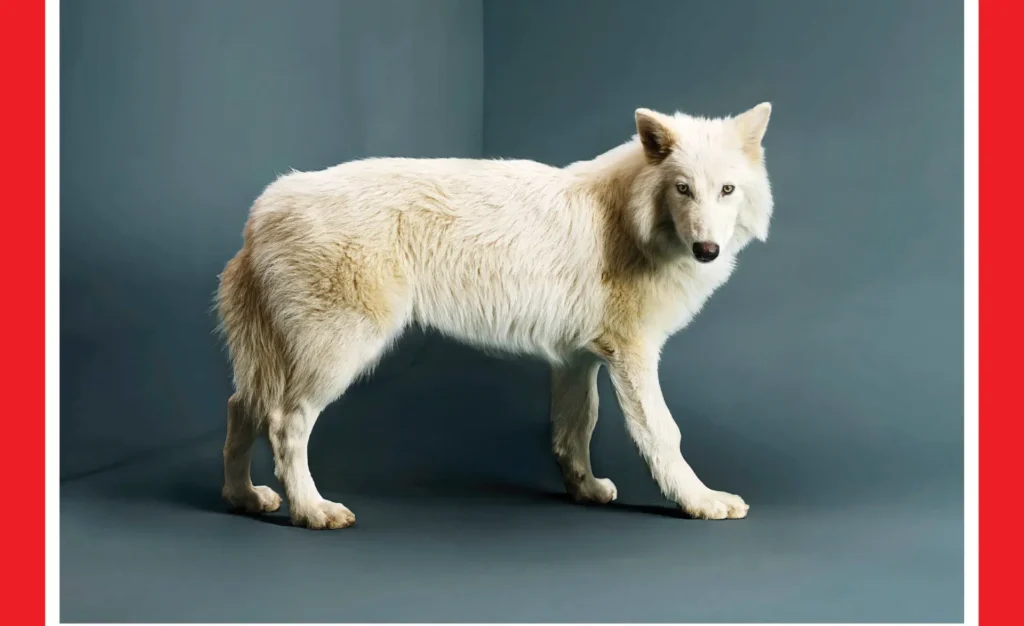
On April 7, 2025, Time magazine put a snow-white wolf pup on its cover. The animal stared straight at the camera, ears slightly cocked, looking less like a textbook predator than a curious dog. Across the image, in the magazine's signature red border type, a single word was struck through: EXTINCT.
It was, as marketing goes, devastating. Within hours, the cover had ricocheted across every science feed, news site, and group chat on the planet. Colossal Biosciences, the Dallas-based de-extinction startup that had spent three years promising to bring back the woolly mammoth, the thylacine, and the dodo, had just played a card nobody saw coming: a fourth species, kept secret until the moment of birth, and already alive on a 2,000-acre preserve. Three pups. Two males, one female. The first vertebrates the company claimed it had pulled back from the dead.
The species: the dire wolf, Aenocyon dirus, an Ice Age apex predator last seen alive roughly 12,500 years ago.
Or had they? Within 48 hours, evolutionary biologists were on television with words like "misleading," "phenotypic," and "genetic cosplay." The pups, critics argued, were not dire wolves at all. They were gray wolves with twenty edits — a tiny patchwork of changes against a genome that had drifted for nearly six million years. Calling them dire wolves, the critics said, was like calling a Tesla Cybertruck a 1957 Chevy because you painted it the same color.
Colossal's chief science officer Beth Shapiro answered the criticism head-on. "If it looks like a dire wolf, and acts like a dire wolf, I'm going to call it a dire wolf." It was a bold claim, and a philosophical one — and the next two years of debate have shown that whether you accept it depends almost entirely on how you define a species in the first place.
This is the story of what Colossal actually did, what they didn't, and why both halves of that sentence matter.
What Was the Dire Wolf?
For most people alive in 2025, the dire wolf is a creature of fantasy. Game of Thrones fans know it as the giant, faintly magical companion of House Stark — a beast the size of a pony, loyal unto death. Dungeons & Dragons players know it as a Challenge Rating 1 monster their level-three rogue probably should not engage. The actual animal was less mystical and more terrifying: a real, evolved predator that hunted the American grasslands for over a hundred millennia.
Aenocyon dirus — formerly classified as Canis dirus, the "fearsome dog" — was the dominant canid of Pleistocene North America. The species ranged from southern Canada to as far south as Bolivia, dominating ecosystems alongside saber-toothed cats, short-faced bears, American lions, and the dire wolf's preferred prey: bison, ground sloths, horses, camels, and the occasional juvenile mammoth. Estimates of body mass put adult dire wolves between 150 and 200 pounds (68 to 90 kilograms), making them roughly 25 percent heavier than the largest modern gray wolves.
But mass is only part of the story. The dire wolf's skull was wider, shorter, and more heavily reinforced. Its teeth were proportionally larger, with deeper carnassial blades and stouter canines suited to crushing bone. Its bite force, estimated from skull mechanics, exceeded that of any living canid by a meaningful margin. Its limbs were proportionally shorter and more robust — built less for marathon pursuit, like a gray wolf, and more for ambush, grappling, and bringing down megafauna at close range. Even its brain told a story: relative to body size, dire wolves had smaller braincases than gray wolves do, suggesting a different cognitive and behavioral profile.
The species' fossil record is among the richest of any large mammal that ever lived, thanks largely to one site: the Rancho La Brea tar pits in central Los Angeles. Over the past century, paleontologists have pulled more than 4,000 individual dire wolves from those asphalt seeps, where animals stuck in tar attracted other predators who themselves became stuck. La Brea has yielded so many dire wolf bones — limb fragments, jaws, intact skulls — that researchers have been able to study population-scale variation in size, sex, age, and pathology. We know how dire wolves fought because we have their healed broken bones. We know what they ate because we have isotope data from their tooth enamel.
What we do not know — at least, not directly — is what they sounded like, how they hunted in packs, what color their fur was, or how they cared for their young. Soft tissue does not survive 13,000 years in tar.
The dire wolf disappeared at the end of the last Ice Age, somewhere between 13,000 and 10,000 years ago. The proximate cause is not mysterious: their megafauna prey base collapsed in the Late Pleistocene extinction event, taking the mammoths, mastodons, ground sloths, and giant bison with it. Specialized hypercarnivores like the dire wolf could not pivot to smaller prey the way more flexible canids could. The gray wolf, smaller and more generalist, survived. Aenocyon dirus did not.
For ten thousand years, that seemed to be the end of the story.
The Dire Wolf Wasn't Really a Wolf
Then, in 2021, Nature published a paper that quietly upended a century of assumptions.
The paper — Perri et al., "Dire wolves were the last of an ancient New World canid lineage" — was the first successful genetic analysis of dire wolf remains. A team led by Angela Perri (then at Durham University) and Kieren Mitchell extracted ancient DNA from five dire wolf specimens recovered from sites across the western United States. The DNA was degraded, fragmentary, and partially contaminated, as ancient DNA always is. But it was readable enough to do something nobody had managed before: place the dire wolf on the canid family tree using molecular data rather than skull measurements.
The result was a shock.
Dire wolves were not closely related to gray wolves. They were not closely related to coyotes. They were not closely related to dholes, jackals, or African wild dogs. The lineage that produced Aenocyon dirus had split from the common ancestor of all those species roughly 5.7 million years ago — before the genus Canis itself even existed in its modern form. Dire wolves and gray wolves were not cousins. They were distant relatives whose last common ancestor predated the divergence of humans and chimpanzees.
The paper's authors went further: they argued that dire wolves were so genetically distinct that they did not belong in the genus Canis at all. The team reinstated an older, almost forgotten genus name — Aenocyon, meaning "terrible dog" — coined in 1918 by paleontologist John C. Merriam and largely abandoned ever since. As of 2021, Canis dirus officially became Aenocyon dirus.
What the dire wolf had, in short, was a textbook case of convergent evolution. It looked wolf-like for the same reason dolphins look fish-like: similar ecological pressures shape similar bodies. The dire wolf's broad skull, powerful jaw, and pursuit-predator build were independent inventions, evolved over millions of years on a separate branch of the tree.
This finding mattered enormously for any future de-extinction project. If you wanted to "bring back" a dire wolf using a living relative as a genetic starting point, you faced a basic problem: there was no close living relative. The gray wolf is not the dire wolf's sibling species. It is its cousin a hundred times removed. Choosing it as a chassis for de-extinction was not because it was genetically similar — it was because it was genetically available, and similar enough in body plan that you could plausibly close the gap with edits.
That choice — and the size of that gap — would become the central scientific controversy of the entire project.
What Colossal Actually Did: 20 Gene Edits
The press release on April 7, 2025 ran to thousands of words. The actual technical claim, stripped of branding, was specific.
Colossal Biosciences had:
-
Sequenced two ancient dire wolf specimens. The first was a tooth from Sheridan Pit, Ohio, dated to roughly 13,000 years old. The second was an inner ear bone (a petrous bone, the densest bone in the mammalian skull and the best ancient DNA reservoir we know of) from American Falls, Idaho, dated to roughly 72,000 years old. Together, the two specimens yielded the highest-quality dire wolf genome ever assembled — orders of magnitude better than the data underlying the 2021 Perri paper.
-
Compared that genome to multiple modern canid genomes — gray wolves, coyotes, jackals, dholes — to identify positions where dire wolves carried distinctive variants. The list of differences ran to thousands of single-nucleotide changes, plus structural variants. Out of that list, the team prioritized variants in genes with clear phenotypic relevance: body size, skull morphology, jaw musculature, fur color, coat texture, ear shape, and limb proportions.
-
Selected fourteen target genes for editing, accounting for twenty specific edits in total. Some of those edits introduced dire-wolf-specific amino acid changes; others were regulatory tweaks affecting how strongly a gene was expressed. Several edits were not lifted directly from the dire wolf genome at all — Colossal has acknowledged that some changes were modeled on related canids when the dire wolf variant was predicted to cause health problems in a living animal. This is an important caveat. Not every edit in these pups is, strictly, a dire wolf sequence.
-
Made the edits in cultured gray wolf (Canis lupus) cell lines using CRISPR-Cas9, deploying multiplex editing — the simultaneous introduction of multiple edits in a single round, rather than one edit at a time. Multiplex editing is technically demanding because each cut increases the risk of off-target effects, chromosomal rearrangements, and cellular stress. The fact that Colossal achieved twenty edits in viable cells is one of the most quantitatively impressive parts of the project.
-
Performed somatic cell nuclear transfer on the edited cells. This is the same cloning technique that produced Dolly the sheep in 1996: the nucleus of a donor cell (here, an edited gray wolf cell) is transferred into an enucleated egg cell from another animal (here, domestic dog eggs, since dog and wolf reproductive cells are highly compatible). The reconstructed egg is then chemically activated to begin embryonic development.
-
Implanted the resulting embryos into domestic dog surrogacy mothers — large hounds whose body size and pregnancy physiology could support the development of wolf-sized fetuses. Multiple surrogates carried multiple implantation cycles. Most pregnancies failed, as is typical for cloning. A few did not.
-
Produced three live, healthy births. Romulus and Remus, two males, were born on October 1, 2024. Khaleesi, a female, was born on January 30, 2025. By the April 7, 2025 announcement, the male pups were six months old, large for their age, and visibly different from typical gray wolf pups: thicker coats, lighter coloration, broader heads.
This is the entire de-extinction pipeline running end-to-end. Ancient DNA sequencing, comparative genomics, target selection, multiplex editing via CRISPR, somatic cell nuclear transfer, surrogacy to term, live birth. Every step had been demonstrated individually before in some form. None of them had ever been chained together in service of a single extinct-species project, with the deliverable being a breathing animal.
That is what makes the dire wolf announcement, regardless of where you land on the species debate, a genuinely historic event.
Romulus, Remus, and Khaleesi
The pups were named carefully. Romulus and Remus, the brothers, drew from the Roman foundation myth — the twin boys raised by a she-wolf, who later founded the city of Rome. Khaleesi, the female, drew from George R.R. Martin's A Song of Ice and Fire, the novel series whose television adaptation made dire wolves a household word. Two names looking back at the deepest roots of Western civilization, one looking forward at the pop culture phenomenon that pre-sold the species to a generation of investors. The branding was not subtle.
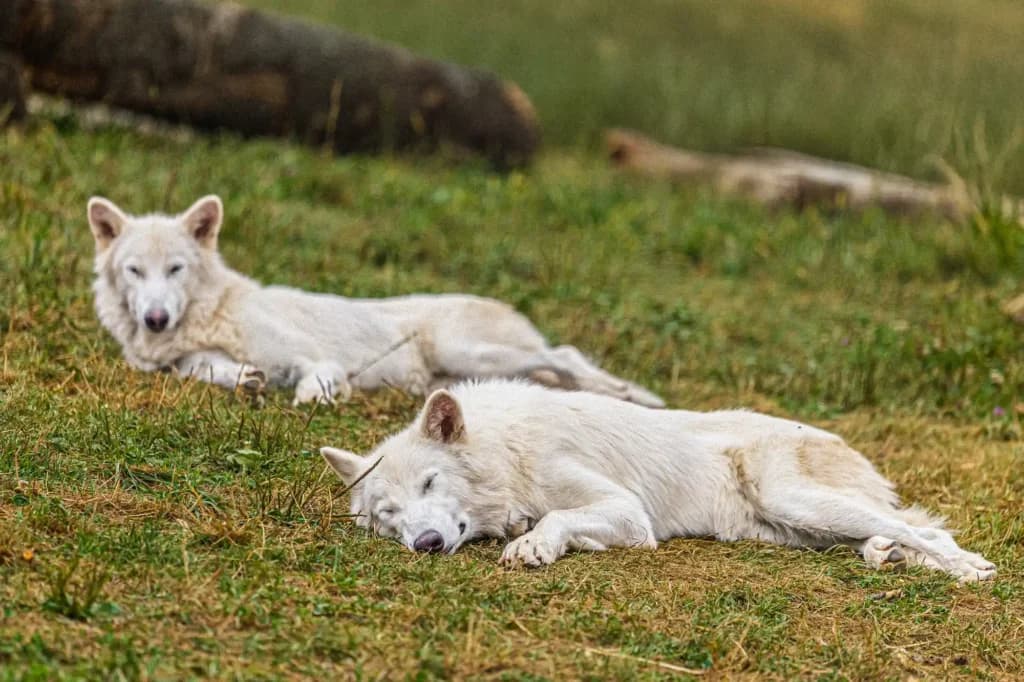
Romulus and Remus were born by Caesarean section on October 1, 2024 to a single domestic dog surrogate, a large hound. They emerged at roughly typical gray wolf birth weights, around one pound each, but began outgrowing their littermates' developmental trajectory within weeks. By six months, both pups weighed close to 80 pounds — substantially larger than gray wolves at the same age. Their coats had grown in white, with dense undercoats and longer guard hairs than typical gray wolves, consistent with the pigmentation and coat-thickness edits Colossal had made. Photographs released to Time and 60 Minutes showed them with broad, blocky heads and the slightly heavier muzzles characteristic of dire wolf skulls.
Khaleesi was born on January 30, 2025 to a different surrogate, also via Caesarean. The four-month gap between her birth and her brothers' was not a planned interval; it reflected the realities of cloning. Surrogates fail. Pregnancies miscarry. A single successful gestation does not predict the next. By the time Khaleesi was two months old at the announcement, she was tracking the same accelerated growth curve as her brothers.
All three animals live on a 2,000-acre private preserve at a location Colossal has not disclosed publicly. The site has multi-tier security: outer perimeter fencing, inner enclosures, on-site veterinary staff, drone surveillance, and round-the-clock monitoring. The pups have not been released into a fully wild environment, and there are no current plans to do so. Colossal has been clear that, even if a viable population were eventually established, any rewilding would happen on private preserves rather than public lands — both for security and to comply with U.S. Endangered Species Act provisions, which do not currently have a legal category for engineered approximations of extinct species.
The pups are also, to date, the most-photographed dire wolves in human history. Which is to say, the only ones.
The Critics' Pushback
The backlash arrived almost immediately, and it came from inside the house — from evolutionary biologists, paleogeneticists, and conservation scientists who had been broadly sympathetic to Colossal's earlier work.
Vincent Lynch, an evolutionary biologist at the University at Buffalo who has worked on mammoth genomics, was among the most direct. "These are gray wolves with twenty edits," he told reporters in the days following the announcement. "Twenty edits, against a genome that's been diverging for almost six million years, is barely a rounding error. This isn't a dire wolf. This is a designer gray wolf with a marketing campaign."
Anders Bergström, a paleogenomicist at the University of East Anglia, focused on the math. The genetic distance between Canis lupus and Aenocyon dirus, he pointed out, accumulates at a roughly clock-like rate. Over 5.7 million years, that distance includes hundreds of thousands of fixed sequence differences and an unknown number of structural rearrangements. Twenty edits, no matter how thoughtfully chosen, cannot bridge that gap. To meaningfully recreate a dire wolf, you would need to make millions of changes — which is currently far beyond anyone's editing technology and probably will be for decades.
Other critics pointed to specific weaknesses in the experimental design. Some of the edits, by Colossal's own admission, were not direct dire wolf sequences but engineered approximations meant to avoid health risks. Some of the targeted phenotypes — coat color, in particular — were inferred from genetic models rather than directly observed in any dire wolf specimen, since pigmentation does not preserve in fossils. The pups' "white coat" trait, in particular, was an aesthetic choice as much as a scientific one. There is no fossil evidence that dire wolves were white. There is genetic evidence that some northern gray wolf populations carry pigmentation variants that produce white coats, and that's the variant Colossal selected.
Beth Shapiro, Colossal's chief science officer and one of the most respected ancient DNA researchers in the world, did not push back hard against the technical critiques. She conceded openly that the pups are not 100 percent genetically identical to ancient dire wolves and were never going to be. The company, she said, had been transparent about the number and nature of the edits from the moment of announcement. The press materials specify "20 gene edits" prominently. Nobody was hiding the math.
What Shapiro did defend was the framing. Colossal, she argued, was practicing functional de-extinction — the recreation not of the exact ancient genome, but of the ancient organism in functional terms. If an animal walks, hunts, looks, and ecologically behaves like a dire wolf, the functional case for calling it a dire wolf is real, even if the genome is mostly gray wolf. "If it looks like a dire wolf and acts like a dire wolf, I'm going to call it a dire wolf," she said. "And we're not going to apologize for that."
The semantic debate became, in many ways, the story. Within a week, mainstream science journalism was running pieces with titles like "Did Colossal really resurrect the dire wolf?" The honest answer was: it depends on what "really" means.
The Real Achievement: De-Extinction Mechanics
Set the species question aside for a moment. Even Colossal's harshest critics have generally conceded that what the company technically pulled off is significant — possibly more significant than the public-facing dire wolf framing suggests.
Until April 2025, the de-extinction pipeline was a sequence of theoretical steps that had never been chained end-to-end for a vertebrate de-extinction project. Each individual step had been demonstrated:
- CRISPR multiplex editing had been used in mice, livestock, and human cell lines, but rarely in canid cells, and almost never with twenty simultaneous edits.
- Somatic cell nuclear transfer had produced cloned dogs, cats, horses, and most famously sheep, but had never been used on heavily-edited cells from a target wild canid.
- Cross-species surrogacy (dog carrying wolf-derived embryos) had been used in red wolf conservation programs, but rarely with edited embryos.
- Carrying engineered embryos to term in surrogates had been done in agricultural genetic engineering, but at much smaller edit counts.
Colossal's contribution was to make the whole chain work, in a single living organism, with the deliverable being a healthy live birth. That is genuinely new. The pipeline that produced Romulus, Remus, and Khaleesi — with appropriate species-specific modifications — should also work for the thylacine (with marsupial-specific reproductive adaptations), the dodo (with avian considerations around primordial germ cells rather than nuclear transfer), and even portions of the woolly mammoth program.
In other words: the dire wolf pups are simultaneously the most contested and the most technically validated de-extinction event in history. The science of what was done to make them is more impressive than the marketing of what they are.
The Red Wolf Conservation Tie-In
Buried near the bottom of the April 7 press release was a second announcement that received roughly one percent of the dire wolf coverage but, in many scientists' view, was the more meaningful piece of news.
Colossal had also produced four cloned red wolves (Canis rufus).
The red wolf is one of the most endangered mammals in North America. By the late 1980s, hunting and habitat destruction had reduced the wild population to fewer than 14 individuals. Captive breeding pulled the species back from the absolute brink, and a small reintroduced population was established in eastern North Carolina in the 1990s. As of 2025, the wild red wolf population numbers somewhere between 20 and 30 individuals — an inbreeding bottleneck so severe that every new genetically distinct animal matters.
Colossal's contribution was to clone four red wolves not from the existing captive population (which would not add genetic diversity) but from biopsy samples taken from coyote-red wolf hybrid animals known as "ghost lineage" individuals. These animals carry rare red wolf alleles that have been lost from the captive population — alleles that, until cloning, were trapped inside hybrid genetic backgrounds and unrecoverable. By cloning the genetic material from those hybrids and selectively breeding it forward, Colossal can in principle reintroduce ancestral red wolf diversity that would otherwise be lost.
This is real conservation. It is not a branding exercise, and it is not phenotypic theater. The four red wolf clones produced through this program carry meaningful genetic value for an endangered species recovery effort. The technique — using cloning to rescue diversity from hybrids — is potentially applicable to dozens of other endangered mammals where similar hybrid populations exist.
That this part of the announcement received so little attention compared to the dire wolf is itself a story about how science communication works. A flashy extinct apex predator with white fur and a Game of Thrones reference moves the cultural needle. A modest but genuinely important advance in red wolf genetic diversity does not.
Colossal knew this. The dire wolves were the headline. The red wolves were the proof of concept that the same techniques can do real conservation work, not just marketing. Both stories are true.
What's a Species, Anyway?
The dire wolf controversy is, in the end, less a scientific question than a philosophical one. There is no single agreed-upon definition of "species" in biology, and the dispute between Colossal and its critics maps almost cleanly onto a hundred-year-old debate about which definition matters.
Three concepts dominate the discussion.
The biological species concept, articulated most influentially by Ernst Mayr in 1942, defines a species as a population of organisms that can interbreed and produce fertile offspring. By this definition, the dire wolf pups are unambiguously not dire wolves. They cannot interbreed with ancient dire wolves (none exist), and they would presumably interbreed freely with gray wolves, since they are 99-point-something percent gray wolf. Under Mayr's framework, they are gray wolves. Full stop.
The phylogenetic species concept, developed in the 1970s and 1980s, defines a species as the smallest population that shares a unique evolutionary history. Under this concept, dire wolves form their own distinct lineage with 5.7 million years of independent evolution, and Colossal's pups — which share none of that lineage — cannot be members of the species Aenocyon dirus. Phylogenetically, they are gray wolves with cosmetic modifications.
The ecological species concept, championed by Leigh Van Valen in 1976, defines a species as a lineage occupying a particular ecological niche. Under this concept, if Colossal's pups grow up to fill the dire wolf's ancient ecological role — a large-bodied pack hunter of megafauna in cold-climate ecosystems — they could be functionally classified as dire wolves regardless of their genome. This is the framework Beth Shapiro has implicitly invoked in defending the project.
There are at least a dozen other species concepts in use. None is universally correct, and biologists have been arguing about the right one for as long as biology has existed as a discipline. The dire wolf debate is partly a scientific debate about edit counts and genome divergence, and partly a much older debate about whether "species" is a fact about ancestry or a fact about ecology.
It is reasonable to find both arguments compelling. It is also reasonable to find one more compelling than the other. What is not reasonable is to pretend that the question has an obvious answer.
What's Next: Dire Wolf 2.0
Colossal has been explicit about what comes next, and the roadmap is more modest than the marketing.
The company plans to produce additional dire-wolf-edited individuals over the next several years, with the goal of establishing a small breeding population. Three pups are not enough to maintain genetic stability; even a captive population needs at least dozens of founders to avoid catastrophic inbreeding. Producing additional founders requires repeating the entire pipeline — multiplex editing, somatic cell nuclear transfer, surrogate gestation — for each new individual. The cost per animal is high, the failure rate is high, and the work is slow.
Beyond simply replicating Romulus, Remus, and Khaleesi, Colossal has stated intentions to add more edits in subsequent generations. The current pups carry twenty edits. Future generations could carry forty, eighty, or two hundred, as the company iterates on which dire-wolf-specific variants are safe to introduce in living animals. Each round of editing adds technical risk and cost, but pushes the phenotype incrementally closer to ancient Aenocyon dirus.
Eventual rewilding, if it happens at all, will be on private preserves — likely Texas or Montana ranches under conservation easement, not federal land. There is no current legal framework in the United States for releasing engineered approximations of extinct species into wild ecosystems, and the regulatory pathway to one would take years if not decades. Colossal has been careful to frame the dire wolves as a species recovery program, not a rewilding program.
Realistic timeline to a viable, semi-wild dire wolf population: five to ten years at the optimistic end, if the technology continues to scale. Possibly never, if technical or regulatory obstacles compound.
The Funding Impact
It would be naive to ignore the business context.
Colossal Biosciences is a venture-backed company. Its investors include Tom Brady, Paris Hilton, Peter Jackson, the CIA's investment arm In-Q-Tel, and a long roster of conventional VC firms. The company's stated mission is de-extinction and biodiversity restoration. Its actual financial structure depends on continued capital raises, and continued capital raises depend on continued visible progress.
The dire wolf announcement was strategically timed. It dropped in the months before Colossal's $200 million Series C funding round, which closed in early 2025 and pushed the company's valuation to $10.2 billion. The visual evidence — actual breathing pups, on actual film, with an actual Time magazine cover — fueled investor confidence in a way that genome assemblies and CRISPR edit counts never could. The dire wolf was, by some distance, the most successful science-PR event in the company's history.
This does not mean the science is fake. The pups exist. The edits exist. The pipeline works. But it does mean that the framing — particularly the choice to call the pups "dire wolves" rather than "dire-wolf-edited gray wolves" — was a marketing decision as well as a scientific one. Colossal is partly a science company and partly a brand company. The dire wolf was the brand event of a lifetime.
A more cautious framing might have generated less press, less investor interest, and less follow-on capital to fund the actual mammoth, thylacine, dodo, and red wolf programs. There is an argument — not necessarily one I endorse, but a coherent one — that the slight overstatement was the price of admission for the rest of the work.
Whether that price was worth paying is, again, a question without a single right answer.
The Bottom Line
Romulus, Remus, and Khaleesi are not pure dire wolves. They are heavily-edited gray wolves with dire-wolf-like phenotypes and twenty intentional changes to their genomes derived from comparison to ancient dire wolf DNA. By the strictest scientific definitions, they belong to the species Canis lupus. By the loosest functional definitions, they could be considered approximations of Aenocyon dirus. By any honest accounting, they sit somewhere in the disputed middle.
Whether that counts as "de-extinction" depends, in the end, on what you came to the question expecting. If you came expecting a literal resurrection of an Ice Age species — an animal genetically indistinguishable from a 13,000-year-old La Brea specimen — you should not call these pups dire wolves, and Colossal has not, in technical disclosures, claimed that they are. If you came expecting living, breathing animals carrying ancient-extinct-species DNA edits and demonstrating phenotypes their parent species had never expressed, then yes, Colossal delivered. The pups exist. The pipeline works.
What it definitely is — what no one disputes — is the first publicly-announced production of large vertebrates carrying engineered edits derived from ancient extinct-species DNA, surviving to live birth, and growing into healthy juveniles. The biological species concept says they are gray wolves. The ecological species concept says they may, eventually, be dire wolves. The phylogenetic species concept says they are emphatically not. Pick your framework.
The pipeline is real. The species question is unresolved. The pups, in 2026, are healthy, growing, and almost a year and a half old.
Time, the species' oldest enemy, will tell.
Sources & Further Reading
- Colossal Biosciences press release and announcement: https://colossal.com/news/ (April 7, 2025)
- Perri, A.R., Mitchell, K.J., Mouton, A. et al. "Dire wolves were the last of an ancient New World canid lineage." Nature 591, 87–91 (2021).
- Shapiro, B. Life as We Made It: How 50,000 Years of Human Innovation Refined — and Redefined — Nature. Basic Books, 2021.
- Time magazine cover story, "The Return of the Dire Wolf," April 2025.
- Lambert, J. "What Colossal Biosciences' Dire Wolves Are — and Aren't." Scientific American, April 2025.
- IUCN Red List entry for the red wolf (Canis rufus): https://www.iucnredlist.org/species/3747/163509841
Last updated: April 2026.