A Bird That Vanished in a Human Lifetime
In the late 1500s, a Dutch trading fleet limped into a humid, forested island in the southwest Indian Ocean. Mauritius had no human inhabitants, no large mammals, and almost no fear. The sailors, hungry and far from home, stepped ashore into a place where the wildlife came to greet them. Among the curious arrivals at the beach was a heavy, gray-brown bird about a meter tall. It walked stiffly on yellow legs, peered at the men with a pale eye, and made no attempt to flee. The Dutch called it walghvogel — "disgusting bird," a reference to the toughness of its meat — but a more enduring name stuck: dodo.
Within roughly eighty years, every dodo on Earth was dead.
Skip forward to a quiet laboratory in Dallas, Texas, in the mid-2020s. Inside an incubator, a clutch of pigeon embryos rests on yolks no bigger than a marble. A technician extracts a tiny pearl of cells from one of the embryos — the precursors to eggs and sperm — and slides them under a microscope. The cells will be cultured, edited with CRISPR to carry stretches of dodo DNA reconstructed from a 350-year-old skull, and then injected back into another developing embryo. If everything works, somewhere down the line, a Nicobar pigeon will lay an egg that hatches into something the world has not seen since the seventeenth century.
That is the bet Colossal Biosciences is making on Raphus cucullatus. It is, in many ways, the strangest of the company's three flagship de-extinction projects — not because the dodo is the most charismatic animal on the list, but because the genetic toolkit for resurrecting a bird barely exists yet. The mammoth and the thylacine ride on decades of mammalian biotechnology. The dodo project is more like building the airplane while flying it.
What Was the Dodo?
Raphus cucullatus was a flightless pigeon — and that is not poetic license, it is taxonomy. Genetic analysis places the dodo squarely inside the Columbidae, the family that includes rock doves, mourning doves, and the iridescent fruit pigeons of Southeast Asia. The dodo's ancestors arrived on Mauritius roughly 25 million years ago, almost certainly by air. Mauritius is a volcanic island that rose from the Indian Ocean floor; nothing walks there, everything flies or drifts. Once on the island, generation after generation of pigeons encountered no mammalian predators, no snakes that could climb to nests, no carnivores at all. There was no advantage to flight. Over millions of years, the lineage's flight muscles atrophied, its body grew, and its wings shrank into useless stubs.
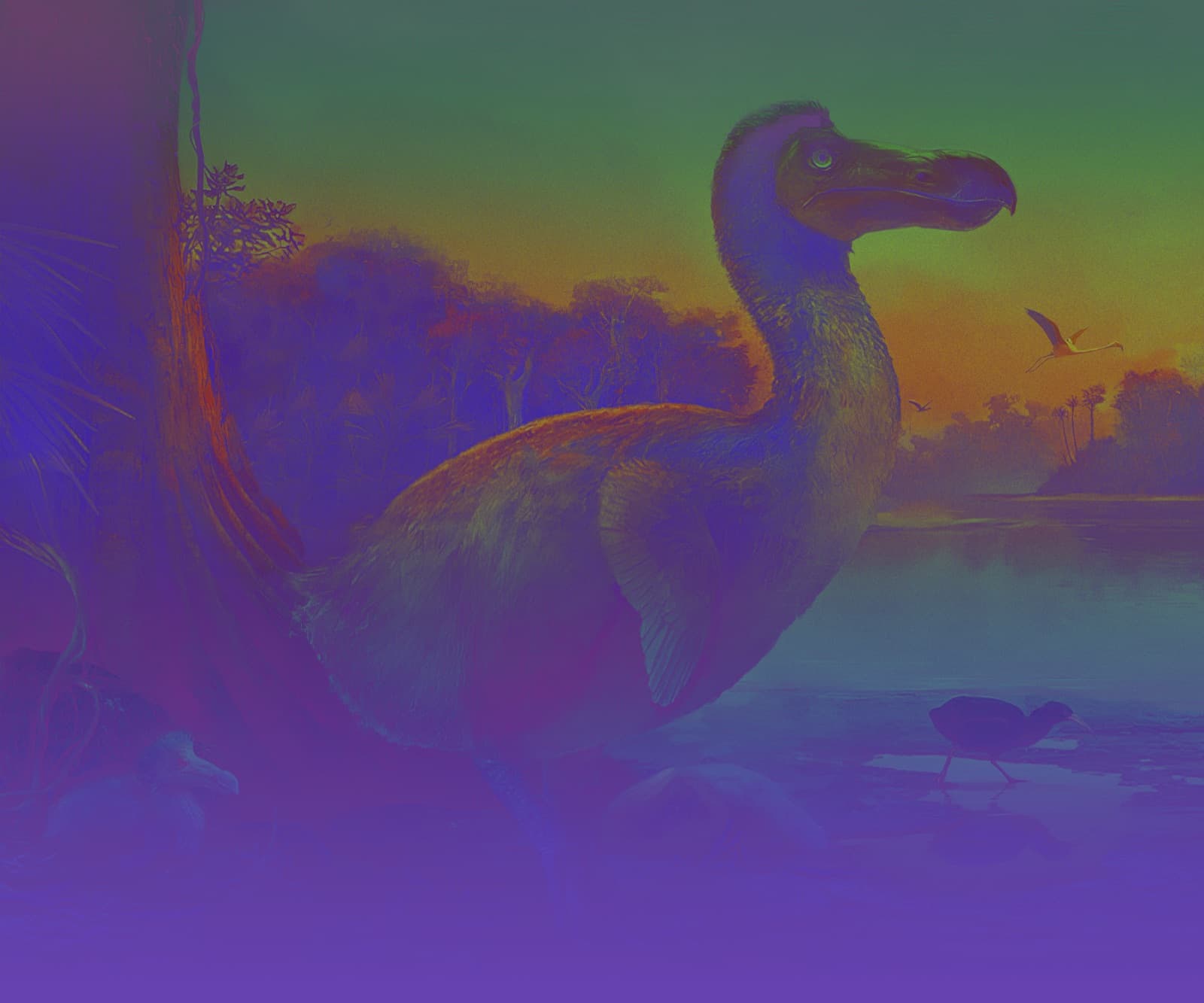
By the time humans first laid eyes on it, the dodo stood about a meter tall and weighed somewhere between 10 and 17 kilograms — the equivalent of a stocky turkey. Contemporary illustrations show a heavy bulbous bill curved at the tip, a tuft of curly feathers where a tail should be, and a flightless body shaped more like a barrel than a bird. The dodo lived on the forest floor, ate fallen fruit and seeds, and nested on the ground. It had no reason to fear anything.
The last verified sighting was recorded in 1662 by a shipwrecked Dutch sailor named Volkert Evertsz, who saw and ate one on a small offshore islet. Some statistical reanalyses of historical records push the likely extinction date to around 1681 — the latest possible window for the species. Either way, the dodo was gone before Sir Isaac Newton finished writing the Principia. By 1904, the phrase "dead as a dodo" had entered common English as a way of saying something is gone for good. The dodo became, and remains, the world's most famous emblem of human-caused extinction.
Why the Dodo Went Extinct
The textbook story is that sailors clubbed dodos to death for food. The truth is more uncomfortable and more instructive.
Dodo meat, by all accounts, was not a delicacy. Dutch records describe it as tough and greasy, edible mostly when better options ran out. Sailors did kill dodos — easy targets that they were — but direct hunting alone probably could not have driven the species to extinction in the time available. The real exterminators arrived in the ships' holds.
Rats jumped from the moored vessels to shore and bred explosively. Pigs, deliberately released by the Dutch as a self-replenishing meat supply, rooted up forest soil and gobbled anything they found. Crab-eating macaques, brought as pets and curiosities, climbed everywhere. Dogs hunted in packs. None of these animals had ever existed on Mauritius, and the dodo had no defenses against any of them. The dodo nested on the ground, laid a single egg per clutch, and had a long maturation period — a recipe for vulnerability. Pigs and macaques ate the eggs. Rats killed the chicks. The adults, slow and confiding, were caught by dogs.
Habitat destruction came on top of all of this. The Dutch, and later the French and British, cut down stretches of native ebony forest for ship timber and farmland. The dodo lost its food, its cover, and its nesting grounds at the same moment its young were being eaten by introduced predators.
The species was extinct within a single human lifetime — perhaps eighty years from first contact. There are no skeletons in any museum that come from a bird scientifically observed in life; almost everything we know about dodo anatomy comes from subfossil bones recovered from a Mauritian swamp called the Mare aux Songes, plus a handful of stuffed museum specimens whose soft tissues largely rotted away in the eighteenth century. The dodo became a symbol — first of stupidity, in the unfair Victorian reading, and now, in our own century, of how casually humans can erase a lineage that took 25 million years to evolve.
Beth Shapiro: The Scientist Leading the Project
If the dodo project has a lead protagonist, it is Beth Shapiro, who joined Colossal as Chief Science Officer in 2024 after a long career at the University of California, Santa Cruz. Shapiro is one of a small group of scientists who built the modern field of ancient DNA — the painstaking work of recovering fragmented, chemically damaged genetic material from museum drawers, frozen soil, and bone fragments thousands or even hundreds of thousands of years old.
Her academic group at UCSC pioneered methods for sequencing genome-scale data from extinct birds, mammoths, and humans, and in 2022 her lab published the first high-coverage assembly of the dodo genome. The work was technically exacting: dodo bone is rare, the surviving museum tissue is heavily contaminated with bacterial DNA, and the bird's genetic information has been sitting in chemically aggressive conditions for centuries. Recovering it required new chemistry, new computational pipelines, and a great deal of patience.
Shapiro is also the author of How to Clone a Mammoth: The Science of De-Extinction (Princeton University Press, 2015), which remains the best general introduction to the field. The book is notable not for cheerleading but for the opposite — Shapiro spends much of it arguing that "de-extinction" in the strict sense is impossible. You cannot, she writes, bring back a species so much as engineer a close functional analog. What matters, she argues, is whether the resurrected animal can do the ecological job the original did: disperse seeds, trample brush, fertilize soil. A 95 percent solution that lives in its native habitat is more valuable than a 100 percent solution that sits in a zoo.
That framing is critical for the dodo. It tells you, in advance, what success will look like.
Reading the Dodo Genome
The 2022 dodo genome assembly came largely from a famous specimen known as the Oxford Dodo — a desiccated head and foot held by the Oxford University Museum of Natural History since the 1680s. The Oxford Dodo is the only known surviving soft tissue from a bird that was probably alive after Europeans had described the species. Tiny samples from the skin and bone yielded short, damaged fragments of DNA which were then computationally stitched into a draft genome by aligning them against the genomes of living pigeons.
What the genome reveals is, in some ways, exactly what evolutionary biologists predicted. The dodo is unmistakably a Columbidae bird. Its closest living relative is the Nicobar pigeon, Caloenas nicobarica, with which it shares a common ancestor probably 30 to 40 million years ago. The second-closest relative is the also-extinct Rodrigues solitaire, Pezophaps solitaria, which lived on a neighboring Mascarene island and went extinct in the 1700s.
By comparing the dodo's genome to those of the Nicobar pigeon and other columbids, Shapiro's group can begin to identify the genes that make a dodo a dodo. The differences are scattered across the genome rather than concentrated in a few obvious "dodo genes," and most of them are regulatory — small changes in when and where a gene is turned on, rather than in the protein the gene codes for. That is consistent with what we know about how body plans evolve in vertebrates generally. Big, visible differences between species — body size, limb proportions, feather color — are usually written in the regulatory tuning of common, conserved genes, not in unique genes that one species has and another lacks.
That regulatory complexity is good news and bad news. Good news because it means the toolkit needed to engineer dodo traits exists in the modern pigeon genome — Colossal does not have to invent dodo genes from scratch. Bad news because it means many small edits, in many places, will be needed to push a Nicobar pigeon's development in the direction of a dodo's.
The Closest Living Relative: The Nicobar Pigeon
If you have not seen a Nicobar pigeon, look one up. Caloenas nicobarica is one of the most spectacular pigeons on Earth — a heavy-bodied bird with a stubby white tail, long iridescent neck hackles in shifting greens and bronzes, and a body plumage that flashes blue, green, and copper depending on the angle of the light. It is native to small forested islands across Southeast Asia, including the Andaman and Nicobar archipelagos that give it its name, and it travels in nomadic flocks between islands.
For Colossal's purposes, the Nicobar pigeon matters for a single reason: it is the dodo's closest living cousin. That makes it the genetic chassis of the project. Cells from a Nicobar pigeon — specifically, its primordial germ cells — will be edited to carry dodo-specific gene variants identified from the ancient DNA work. Those edited cells will then be transplanted into surrogate hosts. Across generations of selective breeding, the dodo-like traits will be concentrated.
The Nicobar pigeon is not endangered in the IUCN's most severe categories, but its populations are in decline due to habitat loss and the cage-bird trade. One of the side benefits of using it as the dodo donor is that the genomic and cell-line resources Colossal develops will become permanent assets for conserving Nicobar pigeons themselves. That pattern — a resurrection project producing tools that help living species — is a recurring theme in Colossal's work, and one we will return to.
The Bird-Specific Editing Problem
Here is where bird de-extinction parts ways with mammalian de-extinction.
Mammals, including the woolly mammoth and the thylacine (which was a marsupial, but still a placental-style live-bearer), develop inside their mothers. That makes the mammalian de-extinction playbook conceptually clean: edit a cell from the closest living relative, fuse the edited nucleus into an enucleated egg, implant the embryo into a surrogate, wait. This is somatic cell nuclear transfer, the technique used to clone Dolly the sheep. It is hard, but it is well understood.
Birds do not work that way. A bird embryo develops on top of a large yolk inside a hard-shelled egg. There is no internal gestation, no maternal blood supply to pipe in nutrients, no convenient implantation step. Once a hen lays an egg, the embryo is sealed inside a closed system that you cannot open, edit, and re-close. Worse, somatic cell nuclear transfer in birds has essentially never worked at production scale — the egg architecture and the early developmental program are wildly different from a mammalian zygote, and the few attempts in chickens have not produced a viable replicable protocol.
That means the standard mammoth-style approach is unavailable for the dodo. You cannot take a Nicobar pigeon skin cell, edit it, and clone a dodo from it. The technology does not exist, and may not exist for decades.
What does exist is a clever workaround that avian biologists have been refining for the better part of twenty years: primordial germ cell engineering.
Primordial Germ Cells: The Avian Workaround
Primordial germ cells, or PGCs, are the embryonic precursors of eggs and sperm. In a developing chick, PGCs first appear in the early embryo, then migrate through the bloodstream to the developing gonads, where they ultimately become the gametes the bird will produce as an adult. Crucially, in birds, PGCs can be extracted from a developing embryo at around stage 14 — roughly 50 to 65 hours into incubation — when they are circulating in the bloodstream. They can then be cultured in a dish, gene editing can be performed on them, and the edited PGCs can be injected into another developing embryo. The host embryo's own germ line is partially or fully outcompeted by the donor PGCs, so when the host bird grows up, it produces sperm or eggs derived from the donor.
This is called germline transmission, and it is the master technique of modern poultry science. It has been demonstrated repeatedly in chickens, in geese, and in several wild bird species. It is the closest thing avian biology has to mammalian iPSC reprogramming, and it is the technology Colossal is betting the dodo project on.
The plan, in outline:
- Establish stable cultures of Nicobar pigeon PGCs. This step alone is non-trivial — PGC cultures have been finicky in non-chicken species, and a robust Nicobar pigeon PGC line is itself a research milestone.
- Use CRISPR-based gene editing to introduce dodo-specific variants into the cultured PGCs. Many edits will be needed; they will be made sequentially or in carefully designed multiplexed rounds.
- Inject the edited Nicobar pigeon PGCs into a surrogate host embryo. The most likely surrogate is a chicken or possibly another columbid; this is one of the engineering choices Colossal has not finalized publicly.
- Hatch the surrogate. As an adult, the surrogate produces gametes derived from the edited Nicobar PGCs.
- Breed those gametes together — surrogate male crossed with surrogate female, or by crossing into a Nicobar background — to produce offspring that carry edits on both chromosomes.
- Across generations, concentrate the dodo edits and select for dodo-like phenotypes.
The animal that emerges from this pipeline will not be a perfect copy of Raphus cucullatus. It will be a heavily edited Nicobar pigeon whose phenotype has been pushed toward the dodo end of the morphological spectrum. Whether you call it a dodo depends on your philosophy of species — the same conceptual question that haunts the mammoth project, sharpened by bird biology.
The Edit List: Which Dodo Traits Get Engineered?
Colossal has not published a definitive edit list for the dodo, and almost certainly the list is still evolving as the genome comparison work continues. But the broad categories are clear from the comparative biology.
Body size. The dodo was perhaps fifty times the mass of a Nicobar pigeon. Body size in birds is regulated by a large network of growth and skeletal-development genes — the IGF1 pathway, GH (growth hormone) signaling, regulators of bone and cartilage growth like genes in the RUNX family, and many more. Most of these will need their regulatory elements adjusted, not their coding sequences. This is the kind of edit that is conceptually simple but requires getting many small things right at once.
Flightlessness and reduced flight musculature. The dodo's wings were vestigial; its sternum lacked the deep keel that anchors a flying bird's flight muscles. Genes governing limb development — including members of the TBX and HOX families and the PITX1/PITX2 limb-identity regulators — shape the proportions of wing versus body. Flightlessness in island birds typically emerges from many small regulatory changes acting together, not from a single "off switch" mutation. Colossal will likely target a panel of regulatory variants identified by comparing the dodo genome to flighted columbids.
Beak shape and size. The dodo's bulbous, hooked bill was probably an adaptation for cracking hard seeds and fruits. Beak morphology in birds is famously sensitive to BMP4 and CALM1 expression levels, as work in Darwin's finches has shown — small tweaks in these regulators can produce dramatic shape differences. The dodo's beak also involved changes in skull bone geometry that will draw on broader craniofacial development genes.
Plumage. Surviving accounts and paintings describe the dodo as gray-brown with possibly some lighter or yellowish tones, and with curly tail feathers in place of a normal pigeon's tail fan. Feather color is governed by melanin pathway genes (MC1R, TYR, ASIP) and, for any iridescence the Nicobar pigeon donates, by structural genes affecting feather barbule architecture. Removing the Nicobar pigeon's spectacular iridescence and producing the dodo's drab gray-brown will likely involve regulatory edits to melanin patterning genes.
Gut microbiome and digestive adaptations. The dodo specialized on hard fruits and seeds, including (perhaps) the famously durable nut of the tambalacoque tree. Its gizzard contained large stones — gastroliths — used to grind tough plant material. Some of these adaptations are anatomical and will fall out of skeletal and developmental edits; others involve digestive enzymes and microbiome composition that are harder to reconstruct from a genome alone. Colossal has acknowledged that the gut microbiome of an extinct island bird is largely lost to history, and that any restored dodo will need to be raised on a curated, modern microbiome.
A recurring theme: most dodo traits are polygenic. There is no single dodo gene any more than there is a single human gene for height. Engineering a dodo means tuning many genes in many tissues, in coordination with each other, while keeping the bird's basic developmental program intact. This is why the project's timeline is longer and less concrete than the mammoth's.
The Mauritius Restoration Plan
A dodo without a Mauritius is a zoo curiosity. Colossal has from the beginning emphasized that the project's endpoint is rewilding, not just hatching, and to that end has partnered with the Mauritian Wildlife Foundation (MWF) — the country's leading conservation NGO and the organization responsible for almost every successful native bird recovery on the island in the last forty years.
The most concrete element of the plan involves Le Morne Brabant, a UNESCO World Heritage site on Mauritius's southwestern peninsula. Le Morne is an isolated mountain massif surrounded by relatively intact forest at lower elevations and steep cliffs above. The combination of geography and existing conservation effort makes it one of the few places on Mauritius where invasive species can plausibly be controlled at scale. MWF and the Mauritian government have done years of work on Le Morne already, removing invasive plants and reintroducing native species. The site is not yet ready for dodos — there are no dodos to introduce — but it is being prepared.
Honesty matters here: invasive species removal on Mauritius is a massive, expensive, ongoing project that has succeeded in pockets and failed in others. The macaques and rats and feral cats that helped exterminate the dodo are still on the island, and removing them from a release zone large enough to support a self-sustaining dodo population is an enterprise comparable in scale to the gene-editing work itself. If de-extinction is the easy half of this project, ecosystem restoration may be the hard half.
Conservation Spillover: The Pink Pigeon
The most underrated argument for the dodo project has nothing to do with the dodo. It has to do with the pink pigeon.
The pink pigeon, Nesoenas mayeri, is endemic to Mauritius. It is a soft-feathered columbid with a pale rose-pink head and breast, and it was reduced in the 1990s to about ten birds — not ten thousand, ten. Heroic captive breeding by MWF and partners brought the population back to a few hundred wild birds, but the species remains genetically depleted, inbred, and vulnerable to disease. It is exactly the kind of population that benefits from precision gene editing: introducing genetic variation, correcting deleterious alleles, and rescuing the species from the genetic drag of its bottleneck.
The PGC infrastructure Colossal needs to build for the dodo — culturing pigeon primordial germ cells, editing them precisely, transmitting edits through the germ line — is the same infrastructure required to do conservation gene editing on the pink pigeon. The same is true for other endangered columbids: the Mauritius blue pigeon, the various endangered fruit doves of the Pacific, even the Manumea (the tooth-billed pigeon of Samoa) which is itself sometimes called "the little dodo." Tools developed for dead birds work just as well on living ones.
This is, in many ways, the strongest conservation argument Colossal can make. Whether or not a recreated dodo ever waddles on Le Morne, the technology will save species that are still here, while there is still time.
The Critics' Case
The objections to the dodo project are real and worth engaging seriously.
The ecological niche is gone. A persistent legend holds that the tambalacoque tree on Mauritius could only germinate after its seeds passed through a dodo's gizzard. This is now widely regarded as a myth — the tree appears to germinate without dodos, and the original 1977 paper that proposed the dodo-tambalacoque link has been challenged by subsequent fieldwork. More broadly, the forest the dodo lived in is gone. A modern dodo would walk into a fundamentally different ecosystem, with fewer native fruits, a different forest structure, and a suite of species — both native and invasive — that the original dodo never coexisted with.
The original killers are still there. Macaques, rats, pigs, dogs, cats: all of the invasive species that exterminated the dodo are still on Mauritius. Releasing dodos into a landscape that still contains the things that killed them is, on its face, a strange plan. Le Morne is being prepared as a controlled site, but a fenced reserve with predator control is closer to a zoo than to wild rewilding.
The technology is immature. Compared to mammalian gene editing, bird PGC editing is a younger and more fragile technology. Stable PGC cultures in non-chicken species are still a research challenge. Multiplex editing in PGCs at the scale needed for the dodo has not yet been demonstrated. The project is partly an applied de-extinction effort and partly a basic-research bet that avian gene editing will mature in time.
The output is not a dodo. Even the best version of the project produces a Nicobar pigeon with dodo-like traits — not a true Raphus cucullatus. Critics argue that calling such an animal a dodo is a category error: it would have a Nicobar pigeon's mitochondrial genome, a Nicobar pigeon's microbiome (or a curated substitute), and only the dodo edits Colossal manages to install on a Nicobar pigeon developmental scaffold. Beth Shapiro herself has made this argument in print. The honest framing is "functional dodo" or "dodo-like bird," and how comfortable you are with that depends on what you wanted from the project in the first place.
These critiques do not, in my reading, kill the project. They just clarify what it is. It is not a time machine. It is a long-term experiment in whether bird gene editing can be pushed far enough to recreate something close to a long-extinct species, with conservation spillover to living species along the way. Judged on those terms, it is defensible. Judged on the terms of "we are going to bring back the real dodo," it is not.
The Timeline
Colossal has been more cautious about timelines for the dodo than for the mammoth or thylacine, and for good reason: bird PGC editing has fewer historical precedents to anchor a schedule against. The company has not committed publicly to a specific year for first hatchings of dodo-trait birds.
A realistic best-case roadmap, inferred from public statements and from how avian PGC research has progressed in chickens, looks something like this:
- 2025–2026: Establish stable Nicobar pigeon PGC cultures. Demonstrate that PGCs can be edited and survive in culture.
- 2026–2027: First proof-of-concept Nicobar pigeon hatchings from edited PGCs. These will likely carry small numbers of edits — perhaps single-trait demonstrations like a feather-color change — to show germline transmission works in this species.
- 2028–2029: Multiplex editing of larger numbers of dodo-relevant variants. First chimeric or hybrid birds with multiple dodo edits.
- 2030 and beyond: Birds that are recognizably dodo-like in size, plumage, and skeletal structure. Whether the first generation of these counts as "a dodo" by anyone's definition is a question for the philosophers of taxonomy.
These estimates are mine, not Colossal's, and they will move as the science moves. They are also likely optimistic. The history of biotechnology timelines is that the first ten percent of the work takes ten percent of the time and the last ten percent takes most of the rest.
The Bottom Line
The dodo project is, in technical terms, the most novel of Colossal's three flagship efforts. Mammoth de-extinction rides on decades of work in cloning, stem cell biology, and reproductive medicine in mammals. Thylacine work draws on a similar mammalian toolkit, adapted to marsupials. The dodo demands a different set of tools — primordial germ cell engineering, multiplex CRISPR in cultured avian cells, germline transmission in non-chicken birds — that are still being invented as the project unfolds.
That makes the dodo project both higher-risk and, in some sense, higher-reward. The risk is that the technical bar is too high and the bird never comes close to existing. The reward — and this is the part that does not require a dodo to ever hatch — is a transformed toolkit for bird conservation. Pigeon PGC editing developed to bring back the dodo is the same technology that can save the pink pigeon, the Manumea, the Mariana fruit dove, the kakapo's relatives, and dozens of other endangered birds whose populations are too small or too inbred to recover by traditional captive breeding alone.
If Colossal hatches a dodo-like bird on Le Morne someday, it will be one of the most arresting moments in the history of biology. If it doesn't, but along the way it gives the field of avian conservation a working gene editing platform — that may quietly turn out to matter more.
The dodo, four hundred years gone, may end up being most useful not when it returns, but in what its return required us to learn.
Sources & Further Reading
- Colossal Biosciences: The Dodo
- Mauritian Wildlife Foundation
- Shapiro, B. How to Clone a Mammoth: The Science of De-Extinction (Princeton University Press, 2015).
- Soares, A. E. R., Novak, B. J., et al. (peer-reviewed work on the dodo and Rodrigues solitaire genomes from the Shapiro lab and collaborators).
- Hume, J. P. Extinct Birds (Bloomsbury, 2nd ed., 2017) — the standard reference on the dodo's natural history and the historical record.
Last updated: April 2026.