David Sinclair
Harvard's highest-profile — and most polarizing — aging scientist
Bio
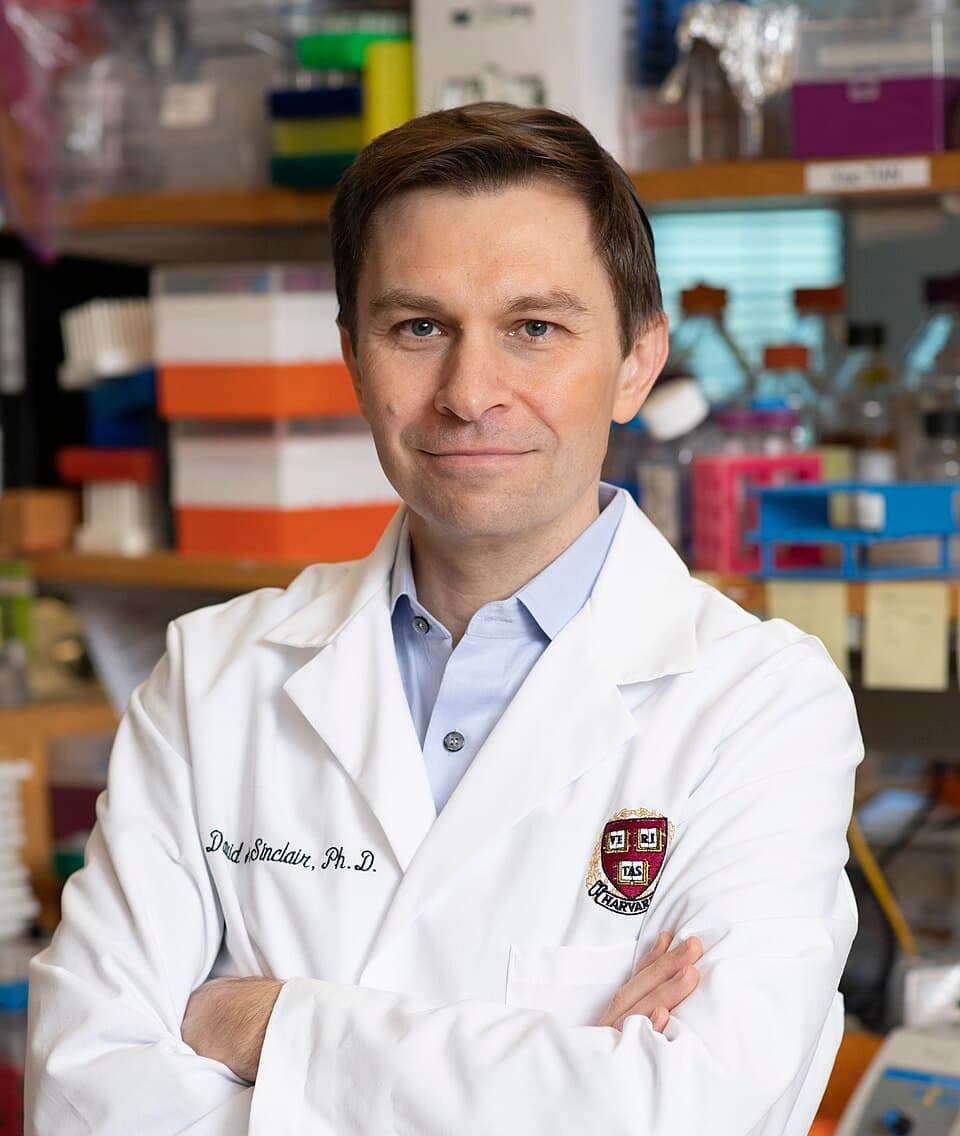
David Sinclair is one of the most cited aging researchers in the world and, by a wide margin, the field's most public-facing scientist. His 2019 book Lifespan articulated his 'Information Theory of Aging' — the idea that aging is driven by a loss of epigenetic information rather than accumulated DNA damage — and made partial cellular reprogramming a household concept among longevity enthusiasts.
Background
Sinclair trained under Leonard Guarente at MIT during the original sirtuin boom of the late 1990s. He joined Harvard Medical School in 1999 and built a lab that has produced influential work on sirtuins, NAD biology, and more recently epigenetic reprogramming. He co-founded Sirtris Pharmaceuticals (acquired by GSK in 2008 for $720M; later shuttered), Life Biosciences, Tally Health, and several other companies — a degree of commercial entanglement that has repeatedly drawn scrutiny.
What They Do
Sinclair's lab currently focuses on partial reprogramming via Yamanaka factors (OSK) as a means of restoring 'youthful' epigenetic states. His headline finding — that OSK can restore vision in aged and glaucoma-damaged mice (Lu et al., Nature 2020) — is genuinely important. He is also a prolific communicator, promoting resveratrol, NMN, metformin, and rapamycin to a lay audience, and has been involved with multiple supplement and biological-age-testing companies. His public claims frequently run ahead of his peer-reviewed data, which has led to repeated public disputes with other aging scientists.
Research Record
Sinclair has a substantial peer-reviewed record with highly cited papers on sirtuins, NAD, and epigenetic reprogramming. Notable works include Lu et al. (Nature 2020) on OSK-mediated restoration of vision and Yang et al. (Cell 2023) on the ICE mouse model of epigenetic aging. His early sirtuin and resveratrol papers remain influential but have also been the subject of long-running replication debates.
Our Evidence Summary
Sinclair is a real scientist whose lab does real work, but he is also the field's clearest example of the gap between what peer-reviewed data support and what a charismatic researcher says on a podcast. His reprogramming work is legitimate and exciting in mice; its human translation is speculative. His NMN/resveratrol claims consistently outrun the human trial data. His commercial entanglements — Sirtris, supplement brands, biological-age testing — are extensive and, at minimum, warrant skepticism of his more enthusiastic public statements.
Claim-by-Claim Evidence Review
Partial reprogramming with OSK factors can restore youthful function in mouse tissues
The Lu et al. 2020 Nature paper showed OSK expression restored vision in aged and glaucoma-damaged mice, and independent groups have reproduced partial reprogramming benefits in other tissues. The mouse data is real, though the mechanism and long-term safety remain open questions.
The 'Information Theory of Aging' — that epigenetic noise causally drives aging — is established
The 2023 ICE mouse paper (Yang et al., Cell) is suggestive but not conclusive. Critics including Charles Brenner and Matt Kaeberlein have argued the ICE mice accumulate off-target damage beyond pure epigenetic change. The theory is a live hypothesis, not settled science.
NMN or NR supplementation extends human healthspan or lifespan
NAD precursors raise blood NAD+ levels in humans, but trial evidence of clinical or longevity benefit in healthy adults is thin and mixed. Most supporting data is from mice or small surrogate-endpoint studies.
Resveratrol activates sirtuins and extends lifespan
The original sirtuin-activator story was complicated by later work showing resveratrol's in vitro sirtuin activation was partly an artifact of the assay. Human trials have not shown consistent clinical benefits. Sinclair's commercial interest in Sirtris makes skepticism appropriate.
Human biological age can be reliably reversed with currently available interventions
Short-term changes in epigenetic clock readouts have been reported from lifestyle interventions, but whether those changes reflect true biological rejuvenation or just noise in the clocks is disputed.
Partial reprogramming is ready or nearly ready for safe human use
No published human data. Tumor risk, delivery challenges, and dose-control problems are serious. Companies including Altos Labs are pursuing this carefully; Sinclair's public timelines have repeatedly outpaced the underlying science.
Metformin and rapamycin show promise as geroscience drugs
Rapamycin has robust mouse lifespan data (ITP); metformin has mixed human observational signals and is being tested in TAME. Framing them as 'promising' is fair; framing them as proven human longevity drugs is not.
Related Reading
Yamanaka Factors & Peptide Reprogramming: The Next Frontier
Yamanaka factors peptide delivery — why protein-based reprogramming with cell-penetrating peptides may be the safest path to clinical partial reprogramming for aging.
Epigenetic Clocks: Measuring Your True Biological Age
Your birthday tells you your chronological age. Epigenetic clocks reveal your biological age — and why the difference matters for longevity science.
The 12 Hallmarks of Aging: A Complete Guide
The 12 hallmarks of aging provide a scientific framework for understanding why we age and where interventions might slow or reverse the process.