Picture a standard letter slot in a front door — roughly 25 centimeters wide and 3 centimeters tall. Now picture a basketball. That, in molecular terms, has been the fundamental problem with delivering CRISPR to most human tissues. The therapeutic payload is too large for the only delivery vehicle that can reliably carry it where it needs to go.
For over a decade, gene therapy researchers have known that adeno-associated virus (AAV) is the gold-standard vehicle for getting genetic cargo inside cells in a living patient. AAV is safe, well-tolerated, remarkably precise when you choose the right serotype, and has already powered several approved gene therapies. But it has a problem: it can only carry about 4.7 kilobases (kb) of genetic cargo. That is a fixed, physical constraint set by the geometry of the protein shell.
SpCas9 — the Streptococcus pyogenes CRISPR enzyme that launched the gene editing revolution — encodes to roughly 4.2 kb of DNA. Add the guide RNA cassette, promoter, and polyadenylation signal the system needs to function in human cells, and you are well past 5 kb total. The basketball does not fit.
This constraint has pushed most CRISPR therapies into ex vivo approaches: remove blood stem cells from the patient, edit them in a dish, and infuse them back. That strategy works brilliantly for blood disorders. It does not work for the brain, the muscle, the eye, or the lung — organs you cannot temporarily remove, edit, and return.
On April 13, 2026, a research team at the University of Texas at Austin, funded by the National Institutes of Health (NIH), published results in Nature Structural & Molecular Biology that change the calculus significantly. They identified a naturally occurring CRISPR enzyme small enough to fit inside a single AAV vector with room to spare, then engineered it to achieve editing efficiencies of more than 80% across tested targets in human cells — with one commonly targeted genomic region reaching 90%. The enzyme is called Al3Cas12f, and its engineered variant, Al3Cas12f RKK, may be one of the most consequential CRISPR tools yet developed.
This article explains exactly what that means, why it matters, and what it will take to get from a human-cell result to a clinical therapy.
Why Delivery Is the Bottleneck
The AAV size constraint is not a workaround problem — it is a physics problem
Adeno-associated viruses are not the only way to deliver CRISPR into cells. Researchers have tried lipid nanoparticles, electroporation, virus-like particles, and direct injection of ribonucleoprotein complexes. Each approach works in specific contexts. But AAV has advantages that other delivery vehicles cannot currently match for in vivo use:
- Tissue targeting: Different AAV serotypes evolved (or have been engineered) to preferentially infect different tissues. AAV9 and AAVrh10 cross the blood-brain barrier and infect neurons. AAV8 traffics predominantly to the liver. AAV2 targets the retina. This natural tropism gives gene therapy developers a built-in targeting system.
- Long-term expression: Once AAV DNA enters a cell's nucleus, it forms circular episomes (extra-chromosomal DNA circles) that persist in non-dividing cells for years without integrating into the host genome. A single injection can provide durable therapeutic effect.
- Clinical track record: Multiple AAV-based gene therapies have received regulatory approval — Luxturna (retinal dystrophy), Zolgensma (spinal muscular atrophy), Hemgenix (hemophilia B) — demonstrating that the manufacturing, dosing, and safety profile of AAV are manageable in the clinic.
But that 4.7 kb cargo limit is non-negotiable. The single-stranded DNA genome of AAV is packaged inside a protein capsid made of exactly 60 capsid protein subunits arranged in an icosahedral structure. The interior volume of that capsid will hold approximately 4.7 kb. Exceed that, and you get truncated genomes, degraded titers, and essentially no therapeutic effect. It is not a guideline — it is physics.
The current workarounds and why they fall short
The field has not been passive about this problem. Several strategies exist:
Dual-AAV delivery splits the Cas9 gene across two separate AAV vectors that must both infect the same cell, after which the two Cas9 halves are stitched back together using split-intein protein splicing or overlapping DNA recombination sequences. The fundamental flaw: both viruses must reach exactly the same cell. In practice, co-infection rates are well below 100%, meaning only a fraction of cells that receive either vector receive both. Manufacturing two separate vectors doubles production complexity and cost.
Smaller Cas9 orthologs offer a partial solution. Staphylococcus aureus Cas9 (SaCas9), at 1,053 amino acids, encodes to about 3.2 kb — tight but workable inside a single AAV. Campylobacter jejuni Cas9 (CjCas9) is even smaller at ~984 amino acids. The tradeoff: these enzymes require more restrictive PAM sequences than SpCas9, severely limiting the number of genomic sites they can target. SaCas9 requires a NNGRRT PAM, which appears roughly every 50 base pairs in the human genome — compared to SpCas9's NGG, which appears roughly every 8 base pairs.
Lipid nanoparticles (LNPs) have no size limit, and they have demonstrated remarkable efficiency in the liver (where they naturally accumulate after systemic administration). But delivering LNPs to the brain, muscle, or lung requires specialized formulations that remain largely experimental. LNPs also raise concerns about repeat-dosing immune responses, limiting them to one-shot therapeutic applications.
None of these workarounds solve the core problem elegantly. The cleanest path has always been to find or engineer a CRISPR effector small enough to fit inside a single AAV, with enough efficiency to drive therapeutic outcomes, while preserving the targeting flexibility that makes Cas9 useful.
Al3Cas12f RKK is the first enzyme to convincingly check all three boxes.
What Is Cas12f?
A different branch of the CRISPR family tree
When most people think of CRISPR, they picture Cas9 — the large, single-protein enzyme from Streptococcus pyogenes that makes a blunt double-strand break at a defined genomic location. But Cas9 is one member of a vast and diverse family of CRISPR-associated proteins. Nature has been running CRISPR experiments for hundreds of millions of years, and the enzymatic diversity that has emerged is staggering.
Cas12f (formerly known as Cas14) belongs to the Type V-F subtype of CRISPR systems. Where Cas9 is a single large protein that does everything — recognizes the guide RNA, identifies the target DNA, and cuts both strands — Cas12f is dramatically more compact, carrying out the same core function in roughly one-third the protein mass.
At 400–500 amino acids, Cas12f enzymes occupy about 1.2–1.5 kb of coding sequence. Inside a single AAV vector, with its 4.7 kb capacity, this leaves approximately 3 kb free — more than enough for:
- A compact mammalian promoter (0.3–0.5 kb)
- A guide RNA expression cassette (0.3–0.4 kb)
- A polyadenylation signal (0.2 kb)
- Optional additional elements (fluorescent reporters, regulatory elements, or even a short donor template for HDR)
The size advantage is not marginal. Fitting a CRISPR system into a single AAV versus dual-AAV is not a 2× efficiency improvement — the relationship is nonlinear. A single-vector system can infect any cell that AAV reaches and edit it. A dual-vector system can only edit cells that both vectors simultaneously infect, which in tissue with variable transduction can reduce effective editing efficiency by 60–90% relative to single-vector.
How Cas12f differs structurally from Cas9
The structural differences between Cas12f and Cas9 are not superficial trimming — they reflect fundamentally different molecular architectures.
SpCas9 is a monomeric enzyme that folds into a bilobed structure, with one lobe handling nucleic acid recognition (the REC lobe) and the other harboring the two catalytic domains that cut each DNA strand (HNH cleaves the complementary strand; RuvC cleaves the non-complementary strand). This organization requires substantial protein mass — thousands of atomic contacts must be maintained to keep the enzyme in the right conformation.
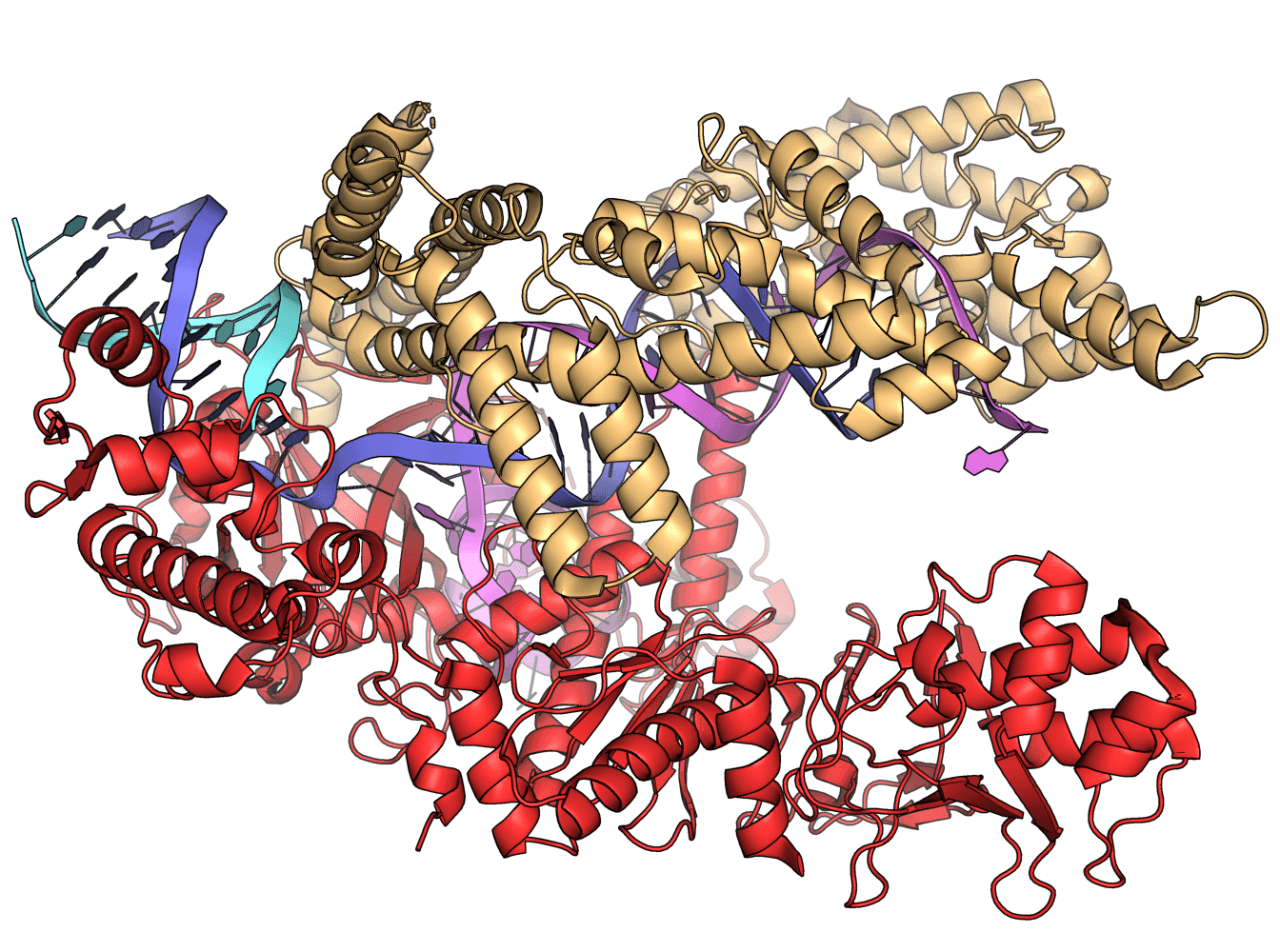
Cas12f uses a different strategy: it functions as a homodimer. Two copies of the ~450 amino acid protein assemble together, along with the guide RNA, to form the active complex. The cryo-EM structure of Cas12f1 (PDB: 7C7L) revealed that the two protomers adopt asymmetric conformations — one plays the primary role in guide RNA loading and target DNA recognition, the other contributes predominantly to DNA cleavage. Together, they distribute the functional workload across two smaller units rather than concentrating everything in one large protein.
This dimeric architecture has important implications. It means that each Cas12f monomer only needs to encode half the catalytic functionality of a Cas9 monomer, enabling the dramatic size reduction. But it also introduces new engineering constraints: if the two subunits don't form a stable, properly oriented dimer, the enzyme fails to function.
The efficiency tradeoff: why wild-type Cas12f wasn't enough
Earlier characterizations of naturally occurring Cas12f variants delivered disappointing results in human cells. Editing efficiencies were typically below 10% — occasionally approaching 20% under optimized conditions, but generally far too low for therapeutic use.
The reason is not mysterious. Cas12f enzymes evolved inside bacteria and archaea, where they function as immune defenses against viral infection. The chromatin environment of a bacterial nucleoid is very different from a human nucleus, where DNA is wrapped tightly around histone proteins in densely packed nucleosome arrays. An enzyme optimized for bacterial DNA access does not necessarily perform well in human chromatin.
This efficiency gap had led many researchers to conclude that Cas12f, for all its size advantages, was simply not viable as a therapeutic tool. The NIH-funded work proved that conclusion wrong.
The Al3Cas12f Discovery
From a gut microbe to a gene editor
Al3Cas12f is a naturally occurring CRISPR enzyme, isolated not from a cultured organism but identified through metagenomics — the sequencing of entire microbial communities without culturing individual species. The enzyme was discovered in sequences classified as belonging to Alistipes bacteria, a genus of Gram-negative, strictly anaerobic organisms that inhabit the human and animal gut microbiome.
The "Al3" designation indicates the third Cas12f ortholog identified from Alistipes-classified sequences. It was not collected from a hot spring or deep-sea vent — it was hiding in ordinary gut microbial DNA, one of billions of sequences in a public metagenomics database that became interpretable only when researchers had the right computational tools to scan for CRISPR effector signatures.
Like all naturally occurring Cas12f variants, the wild-type Al3Cas12f was small — 433–488 amino acids in most characterized variants, giving it a coding sequence of approximately 1.3–1.5 kb. And like all previously characterized wild-type Cas12f enzymes, its editing efficiency in human cells was poor: less than 10% across tested targets.
At first glance, Al3Cas12f appeared to be yet another interesting-but-unusable small CRISPR enzyme. What set it apart was a structural property that the research team identified when they characterized it in detail.
What made Al3Cas12f worth engineering
When the University of Texas team performed comparative structural and biochemical analyses across multiple Cas12f orthologs — the work described in the Nature Structural & Molecular Biology paper by lead author Kaoling Guan and colleagues — Al3Cas12f displayed an unusual property: exceptionally large and stable protein-protein interfaces.
In the Cas12f dimer, the two protein subunits must associate with each other, with the guide RNA, and with the target DNA. The stability of these interfaces determines how efficiently the complex assembles, how long it persists once formed, and how effectively it cleaves. Compared to other Cas12f orthologs, Al3Cas12f exhibited significantly larger interface contacts — the molecular equivalent of a tighter grip.
Biochemical analyses confirmed this stability: Al3Cas12f formed a more preassembled complex, meaning the enzyme+guide RNA complex was already in a catalytically competent configuration before encountering the target DNA. This preassembly is important in the human nuclear environment, where chromatin-associated proteins continuously compete for access to the DNA.
The stability and preassembly characteristics suggested that Al3Cas12f had an unusually robust molecular architecture that might respond well to engineering — that small targeted changes might produce large efficiency gains, rather than the incremental improvements typically seen with other Cas12f variants.
Engineering It: From Less Than 10% to More Than 80%
The engineering strategy: rational design guided by structural insight
The NIH-funded team at UT Austin did not improve Al3Cas12f through brute-force directed evolution — screening millions of random protein variants for improved function. Instead, they used rational protein engineering guided by structural and mechanistic insight.
The key question was: why does Al3Cas12f perform poorly in human cells despite its stable architecture? The answer came from studying how the enzyme interacts with DNA in the human chromatin context. The primary bottleneck was not complex assembly (already better than other Cas12f variants), but rather the efficiency of R-loop formation — the step where the guide RNA strand invades the target DNA double helix, displacing one DNA strand to form the RNA-DNA hybrid that directs cleavage.
R-loop formation in a compact enzyme operating inside human chromatin requires the CRISPR complex to not only find its target sequence but also locally destabilize the DNA duplex enough for the guide RNA to invade. SpCas9 accomplishes this partly through positively charged amino acid residues that interact with the negatively charged DNA backbone, helping to melt the double helix at the target site.
Al3Cas12f's wild-type sequence lacked equivalent positively charged residues at key positions along the DNA-binding interface. The engineering solution was precise: introduce specific arginine (R) and lysine (K) substitutions at positions where electrostatic interactions with the DNA backbone would facilitate R-loop formation.
The RKK mutations
The resulting variant was designated Al3Cas12f RKK — the suffix reflecting the three specific amino acid substitutions introduced: two arginine (R) substitutions and one lysine (K) substitution at structurally identified positions in the protein's DNA-interacting domains.
These three amino acid changes — out of 450+ total residues — transformed the enzyme's performance. The mechanism is well-supported by the structural data: the introduced positively charged side chains (arginine and lysine carry positive charges at physiological pH) contact the negatively charged phosphate backbone of the target DNA, reducing the energetic cost of R-loop formation and enabling more efficient guide RNA invasion.
The efficiency jump was dramatic and consistent:
- Wild-type Al3Cas12f: less than 10% editing across human cell targets
- Al3Cas12f RKK: more than 80% editing across tested targets
- At certain frequently edited genomic regions: up to 90%
Crucially, the improvement was not limited to one easy-to-edit genomic locus. The team tested Al3Cas12f RKK across multiple target sites in human cells and observed robust editing at the majority of them — a critical indicator of broad applicability rather than target-site-specific optimization.
Why these results are significant even before AAV packaging
The 80%+ editing efficiency observed in human cells was achieved with plasmid delivery — injecting the Al3Cas12f RKK gene and guide RNA into cells as DNA plasmids, which is the standard first-pass assay in cell-based editing experiments. The team's next step is to package the system into AAV vectors and test its performance in that context.
This is an important distinction. Efficiency in plasmid-based cell assays does not automatically translate to equivalent efficiency when the same system is packaged inside an AAV and delivered to cells in vivo. AAV delivery introduces additional steps — viral entry, endosomal escape, nuclear transport, uncoating — each of which can reduce the effective dose of functional CRISPR complex reaching the genome. However, the 80%+ figure establishes that the enzyme itself, once inside a human cell, is capable of high-efficiency editing — a necessary (if not sufficient) condition for therapeutic efficacy.
Fitting Inside a Single AAV
The math that makes this different
The size advantage of Al3Cas12f RKK over SpCas9 is not subtle. Consider a fully assembled, functional CRISPR system:
| Component | SpCas9 | Al3Cas12f RKK |
|---|---|---|
| Enzyme coding sequence | ~4,200 bp (~4.2 kb) | ~1,350 bp (~1.35 kb) |
| Compact promoter | ~300 bp | ~300 bp |
| Guide RNA cassette | ~400 bp | ~400 bp |
| Poly-A signal | ~200 bp | ~200 bp |
| Total | ~5,100 bp | ~2,250 bp |
| AAV capacity remaining | Over limit (cannot fit) | ~2,450 bp free |
The ~2,450 bp of remaining AAV capacity with Al3Cas12f RKK is not wasted. It creates options:
- Larger or stronger promoters for higher expression in specific tissues (e.g., neuron-specific promoters like CAMK2A or synapsin for brain delivery)
- Additional regulatory elements to control when and how strongly the enzyme is expressed
- Short donor templates for homology-directed repair (HDR) — enabling not just gene knockout but precise sequence correction
- Regulatory switches that keep the enzyme inactive until a specific small molecule is administered, giving clinicians control over the timing and duration of editing
With SpCas9 in a dual-AAV system, none of these options exist — researchers are already working above the size limit before adding anything extra.
Single AAV versus dual-AAV: why the difference matters for patients
The gap between single-vector and dual-vector delivery is not merely technical — it has profound clinical implications.
Manufacturing: Each AAV serotype must be produced, purified, and quality-controlled separately. Dual-AAV programs require manufacturing two separate viral products, each with its own analytical release testing, for every batch administered to a patient. This roughly doubles manufacturing complexity and cost, which ultimately shapes what patient populations can access a therapy.
Dosing and safety: AAV therapies carry dose-dependent immunogenicity concerns. Higher viral particle counts per dose increase the probability of triggering immune responses — including complement activation and T cell responses against capsid proteins. A dual-AAV system requires administering two full doses (one of each vector) to achieve the same effective editing as one dose of a single-vector system, compounding immune exposure.
Tissue penetration: In solid tissues with complex 3D architecture — the brain, the retina, the myocardium — the probability of any given cell receiving both vectors of a dual system decreases with distance from the injection site. Single-vector delivery maintains therapeutic potential throughout the tissue volume that AAV can reach.
The CNS case: Neurological diseases represent the clearest argument for single-vector compact editors. AAV9 and engineered AAV variants like PHP.B and PHP.eB can cross the blood-brain barrier after systemic administration in animal models, but the dose required to transduce a meaningful fraction of neurons is already at the edge of what human subjects can safely receive. A dual-vector CNS therapy would require double the viral load, likely placing it beyond the safety window entirely. Single-vector compact editors are not merely preferable for CNS delivery — they may be the only viable approach.
What Tissues Could Al3Cas12f Reach?
Tissues that ex vivo editing cannot touch
The promise of a small, efficient, single-AAV CRISPR system is most clearly illustrated by examining the diseases it could address that current approaches cannot:
Brain and central nervous system: Monogenic neurological diseases — Huntington's disease, ALS caused by SOD1 or C9orf72 mutations, spinocerebellar ataxias, certain forms of Parkinson's disease — are caused by expressed mutations in neurons. Neurons are post-mitotic, meaning you cannot remove them, edit them, and return them (ex vivo). The only viable path is in vivo delivery of an editing system to the brain. AAV9, when delivered intravenously or intrathecally, can reach motor neurons, cerebellar neurons, and cortical neurons. A compact CRISPR system riding inside AAV9 could, in principle, reach and edit these cells.
Skeletal muscle: Duchenne muscular dystrophy (DMD) is caused by mutations in the gene encoding dystrophin — the largest gene in the human genome at 2.4 Mb. Exon-skipping strategies to partially restore dystrophin function have been pursued with dual-AAV Cas9 approaches with limited success. A compact single-vector system removes one of the major obstacles, potentially enabling higher editing efficiency in muscle fibers across the body.
Retina: The eye is an AAV-accessible, immunologically privileged compartment that has already seen the first approved AAV gene therapy (Luxturna, for RPE65 mutations causing inherited retinal dystrophy). Compact CRISPR editors could extend in vivo editing to a broader range of retinal diseases, including dominant conditions where a toxic gain-of-function allele must be knocked out rather than supplemented.
Lung: Cystic fibrosis and alpha-1 antitrypsin deficiency are compelling targets, but AAV delivery to airway epithelium remains inefficient, and the cells are rapidly turned over — limiting episomal AAV persistence. Compact CRISPR integration into lung epithelial genomes (rather than episomal expression) might provide durable benefit here, though achieving integrating expression from AAV requires additional engineering.
Liver: The liver is already well-served by LNP delivery of CRISPR systems, where LNPs naturally accumulate. But for patients who may need repeat editing or where LNP immunogenicity is a concern, AAV delivery remains relevant — and Al3Cas12f's compact size leaves room for liver-specific promoters that restrict expression to hepatocytes.
What AAV serotype targeting enables
The tissue reach of any AAV-delivered therapy depends on which serotype is used. The Cas12f coding sequence is small enough to pair with the Cas12f expression system and deliver it in any of the established clinical AAV serotypes:
- AAV9: Blood-brain barrier penetration; used in Zolgensma for spinal muscular atrophy
- AAV8: Liver-tropic; used in hemophilia gene therapies
- AAVrh10: Muscle and CNS
- AAV2: Retina, liver
- Engineered variants (PHP.eB, LK03, NHP variants): Various tissue tropisms under clinical investigation
Because Al3Cas12f's total payload is approximately 2.25 kb, researchers have up to 2.45 kb to work with for tissue-specific regulatory elements, guide RNA expression cassettes, and safety switches — none of which is available when working with SpCas9.
Where Al3Cas12f Sits in the Compact CRISPR Landscape
Context: February 2026 already marked a turning point
This article focuses on Al3Cas12f specifically, but it is worth situating the discovery within the broader compact CRISPR landscape that has developed over the past several years. A companion article on this site — Beyond Cas9: The New CRISPR Editors Reshaping In Vivo Gene Therapy in 2026 — covers that broader landscape in detail.
In brief, the compact editor field has advanced considerably since the early days when only SaCas9 offered a smaller-than-SpCas9 option. Several relevant comparison points:
| Editor | Type | Size (aa) | Efficiency in human cells | Fits single AAV? |
|---|---|---|---|---|
| SpCas9 | II | 1,368 | 70–95% | No (dual AAV only) |
| SaCas9 | II | 1,053 | 50–80% | Tight fit (~0 kb room) |
| CjCas9 | II | 984 | 40–70% | Tight fit (~0.3 kb room) |
| CasX/Cas12e | V-E | ~980 | 40–70% | Fits (~1.1 kb room) |
| CasMINI | V-F | ~529 | 30–70% | Fits (~2 kb room) |
| Un1Cas12f1 (engineered) | V-F | ~422 | 20–50% | Fits (~2.3 kb room) |
| Al3Cas12f RKK | V-F | ~450 | >80% (up to 90%) | Fits (~2.45 kb room) |
The comparison reveals why Al3Cas12f RKK is significant: it combines the smallest size tier (comparable to CasMINI and other Cas12f variants) with efficiency that matches or surpasses SpCas9 — something no previous compact editor had achieved consistently across multiple genomic targets.
What distinguishes Al3Cas12f from CasMINI
CasMINI deserves special mention as the pioneering compact editor that demonstrated the Cas12f family could be engineered for meaningful human-cell activity. Published by Stanley Qi's lab at Stanford in Cell in 2021, CasMINI was engineered from a different Cas12f ortholog (Un1Cas12f1) and showed editing rates of 30–70% depending on the target site.
Al3Cas12f RKK advances beyond CasMINI in three ways:
-
Efficiency floor: While CasMINI's efficiency varies considerably by target site — with some targets showing only 10–20% editing — Al3Cas12f RKK maintained robust performance across all tested targets, with a higher floor.
-
Structural mechanism: The Al3Cas12f engineering work provided clear mechanistic insight into why the RKK mutations improve performance (enhanced DNA backbone contacts improving R-loop formation), enabling rational future optimization rather than trial-and-error.
-
Stability architecture: The unusually large dimer interface of Al3Cas12f — greater than that of comparable Cas12f variants — appears to provide a more preassembled, conformationally stable active complex, which may translate to more consistent performance across different nuclear environments.
How it compares to CasX
CasX (classified as Cas12e), discovered in 2019 from metagenomic analysis of groundwater samples and licensed exclusively to Scribe Therapeutics, is the other primary compact editor under serious clinical development. At ~980 amino acids, CasX fits inside a single AAV but with considerably less headroom than Al3Cas12f — roughly 1 kb of space remaining versus Al3Cas12f's ~2.45 kb.
CasX's advantage is that Scribe Therapeutics has invested substantially in engineering improved CasX variants (their X-Editing (XE) platform) and has specific clinical programs in advanced development, including collaborations with Eli Lilly for neurological disease targets.
Al3Cas12f RKK's advantage is its smaller size (providing more payload flexibility) and the efficiency results reported in the April 2026 paper. Whether these advantages translate into clinical superiority will depend on in vivo testing in animal models and, ultimately, human clinical trials.
PAM compatibility: an underappreciated advantage
One detail often overlooked in size comparisons: Al3Cas12f's PAM compatibility. Like other Cas12f family members, Al3Cas12f recognizes a T-rich PAM sequence (5'-TTTV-3' or similar T-rich motifs). This is largely complementary to SpCas9's G-rich NGG PAM.
In practice, approximately 25–30% of the human genome lacks SpCas9-compatible NGG PAM sites within 20 base pairs of a desired editing target. For those genomic regions, SpCas9-based therapies simply cannot access certain mutations — not because of efficiency, but because the PAM is absent. Al3Cas12f's T-rich PAM preference expands the editable space of the human genome, potentially enabling therapy for patients with mutations that no current editor can reach.
From Lab to Clinic: What Comes Next
The gap between human cells and a clinical IND
The April 2026 Nature Structural & Molecular Biology paper establishes that Al3Cas12f RKK is a high-efficiency genome editor in human cells. That is a necessary but far-from-sufficient condition for clinical use. The pathway from this result to an Investigational New Drug (IND) application — the regulatory step that permits first-in-human dosing — typically spans three to five years and requires demonstrating:
1. AAV packaging efficiency: The full system (Al3Cas12f RKK coding sequence + guide RNA + regulatory elements) must be packaged into AAV at high titer and demonstrated to transduce target cells efficiently in vitro. The size math strongly suggests this will work, but viral packaging of any construct can reveal unexpected issues — secondary RNA structures that interfere with packaging, sequence motifs that reduce titer, or expression levels lower than those achieved with plasmid delivery.
2. In vivo efficacy in rodents: The standard next step is demonstrating editing efficiency in mouse (or rat) models of the target disease. This tests both the AAV-packaged system's efficiency and the downstream therapeutic effect — does editing the right gene actually improve the disease phenotype?
3. Large animal studies: Regulatory agencies typically require non-human primate (NHP) data before an IND can be filed for CNS or systemic therapies. NHP studies test pharmacokinetics, biodistribution, and early safety signals in a primate immune system more similar to humans.
4. Off-target profiling: The engineered Al3Cas12f RKK must be comprehensively profiled for off-target DNA cleavage at genomic sites with sequence similarity to the intended target. The RKK mutations that improve on-target efficiency could theoretically also increase off-target activity — though the structural rationale (electrostatic enhancement of R-loop formation) would be expected to benefit on-target sites more than off-target sites, which already have fewer contact points. This needs to be verified empirically.
5. Immunogenicity assessment: Al3Cas12f originates from an Alistipes gut bacterium — not a human pathogen, but a bacterium that humans carry in their gut microbiome. Whether humans have pre-existing immune responses to Al3Cas12f (either T cell immunity to the protein or antibodies to the ortholog) needs to be characterized. Pre-existing immunity could neutralize the AAV-delivered enzyme before it can act or trigger dangerous inflammatory responses.
6. Manufacturing scale-up: Academic-scale AAV production (bench-top bioreactors producing milligram quantities) is very different from clinical-scale production (large bioreactors producing gram quantities under GMP conditions). Scale-up can take 18–24 months even for an established manufacturing process.
Metagenomi Therapeutics and commercialization
The collaboration between the University of Texas at Austin team and Metagenomi Therapeutics, the Bay Area biotech company that co-authored the Nature Structural & Molecular Biology paper, is a significant signal about Al3Cas12f's clinical trajectory.
Metagenomi was founded to mine metagenomic databases for novel CRISPR systems and engineer them for therapeutic use — precisely the strategy that led to Al3Cas12f's identification and engineering. The company published a press release announcing the Nature Structural & Molecular Biology publication, noting Al3Cas12f as a proprietary compact CRISPR nuclease, suggesting it holds or is pursuing intellectual property around the enzyme.
This is relevant for the field because commercialization determines clinical development timelines. Metagenomi has the infrastructure to move Al3Cas12f RKK into IND-enabling studies faster than an academic lab working alone. The key questions are which disease indication they will prioritize first and whether they will develop the therapy in-house or partner with a larger gene therapy company.
Disease indication priority
Researchers have not publicly committed to a specific first clinical indication for Al3Cas12f RKK. However, the characteristics of the enzyme — single-vector AAV packaging, high efficiency across multiple cell types, T-rich PAM — suggest several priority candidates:
- CNS diseases (ALS, Huntington's, spinocerebellar ataxia): The highest unmet need for single-vector compact editors; the limitation of current dual-AAV Cas9 approaches is most acute here
- Duchenne muscular dystrophy: Muscle is well-transduced by AAVrh10; compact editing of the dystrophin exon architecture to restore reading frame is a validated strategy
- Retinal diseases: The immunologically privileged ocular space and proven AAV delivery track record make the eye an attractive first target
- Transthyretin amyloidosis (ATTR): Liver-targeting with AAV8 or LNP; TTR knockdown is a validated therapeutic target with already-approved therapies, providing a clear clinical benchmark
Open Questions
What we don't yet know about Al3Cas12f RKK
Rigorous science requires being explicit about what the April 2026 paper establishes versus what remains uncharacterized. Several important questions await the next round of experiments:
Off-target activity of the engineered variant: The RKK mutations improve on-target efficiency by enhancing DNA backbone contacts. Do they also increase the enzyme's tolerance for mismatched DNA at off-target sites? The paper characterized on-target editing efficiency comprehensively, but genome-wide off-target profiling using unbiased methods (GUIDE-seq, CIRCLE-seq, or Digenome-seq) is not yet reported in the literature. This is a critical gap before any clinical application.
In vivo performance after AAV packaging: As noted above, the 80%+ efficiency figures come from plasmid-based delivery in human cells. The team acknowledges that testing in AAV is the critical next step. AAV packaging can reduce effective expression levels, and the chromatin environment in vivo in a specific tissue may differ meaningfully from standard HEK293 or HeLa cell lines used for in vitro benchmarking.
Pre-existing immunity: Alistipes bacteria are common human gut residents. Whether humans carry immune memory against Alistipes proteins — including Cas12f — is unknown. For AAV-delivered CRISPR therapies, pre-existing T cell responses against the transgene product (the Cas12f protein) can lead to elimination of edited cells by the immune system, potentially abolishing therapeutic benefit over time.
Guide RNA compatibility: The Al3Cas12f guide RNA architecture — the precise structure of the crRNA and any tracrRNA-equivalent elements — may require optimization for different target sequences or tissue contexts. While the paper demonstrates broad activity across multiple tested loci, systematic guide RNA design rules for Al3Cas12f RKK are not yet as well-developed as those for SpCas9, which benefits from a decade of high-throughput screening data.
Long-term editing stability: The paper reports editing in human cells after acute delivery. Whether edited cells maintain stable gene disruption over weeks, months, or years — without reversion or epigenetic silencing of the guide RNA cassette — requires longitudinal experiments that take time to complete.
Multiplexing: Can Al3Cas12f RKK be used to edit two or more targets simultaneously using a single guide RNA array? Some Cas12 family members naturally process multi-guide RNA arrays; whether Al3Cas12f RKK supports multiplexed editing with maintained efficiency at each target is an open and practically important question for complex disease applications.
The immune response problem is not unique to Al3Cas12f
It is worth noting that the immunogenicity concern is not an Al3Cas12f-specific problem — it affects the entire field of in vivo CRISPR delivery. Studies have found that 58–80% of human donors have pre-existing antibodies against SpCas9, likely due to prior infections with Streptococcus pyogenes. SaCas9 from Staphylococcus aureus shows similar pre-existing immunity rates because Staph is a common human pathogen.
Al3Cas12f from Alistipes, a gut commensal rather than a pathogen, might actually have a lower pre-existing immunity rate in humans — a potential advantage over Cas9-derived enzymes. But this is speculative until serological surveys are conducted.
The Bigger Picture
This is a platform, not just a therapy
It would be a mistake to view Al3Cas12f RKK as a single therapeutic candidate. It is better understood as a platform — a validated, compact, efficient CRISPR enzyme that can in principle be paired with any guide RNA targeting any genomic sequence, packaged in any AAV serotype, and directed to any tissue that AAV can reach.
Gene therapy companies have long sought such a platform: a single-vector, high-efficiency editing tool with no fundamental tissue restrictions. SpCas9's size limitation forced the field into a series of imperfect compromises. Al3Cas12f RKK, if its in vitro performance holds in vivo, removes the most fundamental of those compromises.
The implications extend beyond gene knockout. The compact size of Al3Cas12f creates the possibility of pairing the enzyme with base editor or prime editor machinery — or at least short donor templates — within a single AAV. Compact base editors (like the ABE8e or CBE4max variants) are already being developed with smaller Cas proteins; swapping the Cas component for Al3Cas12f could enable precise single-nucleotide corrections with single-vector delivery, a combination that does not exist with current tools.
A field reaching an inflection point
This breakthrough does not exist in isolation. February 2026 saw the broader compact editor landscape surveyed and characterized. April 2026 brought Al3Cas12f RKK's performance data. Other groups are engineering hpCasMINI, hpOsCas12f1, and additional Cas12f variants with improved performance. The cryo-EM structural database for Cas12f enzymes now spans dozens of deposited structures, enabling structure-guided engineering at a depth that was not possible three years ago.
The field is reaching an inflection point where the tools required for robust in vivo CRISPR gene therapy — small enough, efficient enough, specific enough — may all be converging simultaneously. Al3Cas12f RKK represents one of the clearest demonstrations to date that compact CRISPR enzymes can match or exceed SpCas9's efficiency without its size penalty.
Whether the clinical fruits of this science arrive in three years or ten will depend on factors far removed from molecular biology — regulatory timelines, manufacturing capacity, commercial investment, and the difficult process of identifying the patient population that represents the most compelling first clinical bet. But the molecular case for Al3Cas12f as a serious clinical candidate is now substantially stronger than it was before April 2026.
Sources & Further Reading
- NIH-funded breakthrough shrinks CRISPR for precision delivery in the body — NIH official press release, April 2026
- Compact CRISPR system unlocks targeted in-body gene editing, with up to 90% efficiency — Phys.org, April 2026
- Comparative characterization of Cas12f orthologs reveals mechanistic features underlying enhanced genome editing efficiency — Guan, K. et al. Nature Structural & Molecular Biology (2026). DOI: 10.1038/s41594-026-01788-6
- Metagenomi Therapeutics announces publication in Nature Structural & Molecular Biology — GlobeNewswire, April 16, 2026
- New bite-sized CRISPR molecule may open doors for therapeutic genome editing — EurekAlert!, April 2026
- Engineered Miniature CRISPR Boosts Gene-Editing Efficiency in Human Cells — GEN, April 2026
- Compact CRISPR Cas12f Breakthrough Could Unlock AAV-Based In Vivo Gene Editing — PackGene Biotech, April 2026
- Efficient CRISPR editing with a hypercompact Cas12f1 and engineered guide RNAs delivered by adeno-associated virus — Kim, D.Y. et al. Nature Biotechnology (2022) — earlier Cas12f-AAV compatibility work
- hpCasMINI: An engineered hypercompact CRISPR-Cas12f system with boosted gene editing activity — Nature Communications (2025) — related compact Cas12f engineering work
- RCSB PDB Structure 7C7L: Cryo-EM structure of the Cas12f1-sgRNA-target DNA complex — https://www.rcsb.org/structure/7C7L
- Overcoming the AAV Size Limitation for CRISPR Delivery — Addgene blog, overview of the packaging problem
Last updated: April 2026.


