
Every medicine you have ever taken — every pill, every infusion, every gene therapy — traveled an extraordinarily long road before it reached you. On average, that road stretches 10 to 15 years and costs between $1 billion and $2 billion. It begins in a laboratory, passes through years of animal studies, navigates a gauntlet of federal regulations, and ultimately depends on thousands of patients who volunteer to test something that has never been tried in humans before.
Clinical trials are the engine that makes all of this possible. They are how we know that a therapy works, how we learn what its side effects are, and how regulators like the U.S. Food and Drug Administration (FDA) decide whether to let a treatment reach the public. If you or someone you care about is living with a serious illness — especially a genetic disease — understanding how clinical trials work is not just academic. It is practical, personal, and potentially life-changing.
This guide walks through every stage of the clinical trial process, from the earliest laboratory experiments to what happens after a drug is approved. We will explain what each phase means, how gene therapy trials differ from traditional drug trials, what it actually feels like to participate as a patient, and what the realistic odds of success look like. The goal is to give you an honest, clear picture so you can make informed decisions about your own health.
Step 1: Preclinical Research — Where It All Begins
Long before a therapy is tested in a single human being, it goes through years of preclinical research. This is the foundational work that happens in laboratories and, eventually, in animal models.
During the preclinical phase, scientists are asking the most basic questions. Does this molecule, protein, or gene editing tool actually do what we think it does? Can we deliver it to the right cells? Is it toxic? What happens to animals that receive it?
Preclinical research typically involves two stages:
-
Laboratory studies (in vitro): Scientists test a therapy on cells in dishes. For a gene therapy, this might mean using CRISPR or an AAV vector to edit cells in a petri dish and measuring whether the intended genetic change occurred. Researchers also study off-target effects — whether the therapy accidentally alters DNA in places it should not.
-
Animal studies (in vivo): If lab results are promising, the therapy moves into animal models — usually mice first, then sometimes larger animals like non-human primates. Animal studies provide critical safety data. They reveal how the therapy distributes in the body, whether it triggers an immune response, and whether it causes any organ damage.
Preclinical research can take three to six years. The vast majority of candidate therapies fail at this stage. One widely cited analysis from the Biotechnology Innovation Organization found that approximately 90% of drug candidates that enter clinical testing ultimately fail, and the attrition before clinical testing is even steeper (BIO, 2021). This is not a flaw in the system. It is the system working as intended, filtering out candidates that are not safe or effective enough to test in people.
Step 2: The IND Application — Asking Permission to Test in Humans
Once a company or research team believes their preclinical data is strong enough, they file an Investigational New Drug (IND) application with the FDA. This is the formal request to begin testing in humans.
The IND is a substantial document. It includes:
- All preclinical data — Every laboratory experiment, every animal study, every safety signal
- Manufacturing information — How the therapy is made, what quality controls are in place
- A proposed clinical trial protocol — The detailed plan for how the human study will be conducted, including how many patients will be enrolled, what doses they will receive, what endpoints will be measured, and how safety will be monitored
- Investigator qualifications — Who will run the trial and whether they are qualified to do so
The FDA has 30 days to review an IND application. If the agency does not raise objections — called a "clinical hold" — the trial is automatically allowed to proceed. The FDA can also place a full or partial hold if it has safety concerns or believes the study design is inadequate (FDA, 2023).
Filing an IND is a major milestone. It means a therapy has cleared every preclinical hurdle and that federal regulators have agreed it is reasonable to begin human testing.
Step 3: Phase 1 — Is This Therapy Safe?
Phase 1 is where a therapy first enters a human body. The primary goal is not to cure anyone. It is to answer one critical question: Is this therapy safe?
Phase 1 trials are small, typically enrolling between 20 and 80 participants. For conventional drugs, these participants are often healthy volunteers — people without the disease who agree to take the experimental therapy so researchers can study its basic safety and how the body processes it (pharmacokinetics). For gene therapies and cancer treatments, however, Phase 1 participants are almost always patients with the disease, because the potential risks of permanently altering DNA or using potent biological agents are too significant to expose healthy people to.
During Phase 1, researchers carefully escalate doses. The first group of patients receives a very low dose. If no serious safety problems emerge after a waiting period, the next group receives a slightly higher dose. This process, called dose escalation, continues until researchers identify the dose that appears to balance safety and biological activity.
Phase 1 trials typically last several months to a year. Participants undergo frequent blood tests, imaging scans, and clinical evaluations. The monitoring is intensive — and intentionally so. At this stage, researchers are gathering every data point they can about how the therapy behaves in a living human body.
Historically, about 66% of therapies that enter Phase 1 advance to Phase 2 (Wong et al., Biostatistics, 2019). The rest are halted, usually because of unacceptable side effects or because the therapy does not show enough biological activity to justify further investment.
Step 4: Phase 2 — Does This Therapy Actually Work?
If Phase 1 establishes that a therapy is reasonably safe, Phase 2 asks the next logical question: Does it work?
Phase 2 trials are larger, enrolling between 100 and 300 patients. These participants all have the disease the therapy is intended to treat. The goals of Phase 2 are to gather preliminary evidence of efficacy — measurable clinical improvement — and to refine the optimal dose.
Phase 2 trials may be randomized, meaning some patients receive the experimental therapy while others receive a placebo or the current standard of care. This comparison helps researchers distinguish between genuine treatment effects and improvements that might have happened anyway. However, for serious and life-threatening diseases, Phase 2 trials may use a single-arm design where all patients receive the therapy, with outcomes compared to historical data.
Phase 2 is often described as the "valley of death" in drug development. It is the stage where the most promising therapies fail — not because they are unsafe, but because they simply do not work well enough. Only about 29% of therapies that enter Phase 2 advance to Phase 3 (Thomas et al., Clinical Pharmacology & Therapeutics, 2016). This stark attrition rate reflects how difficult it is to translate laboratory success into real clinical benefit.

Step 5: Phase 3 — The Definitive Test
Phase 3 is the final and most rigorous stage of clinical testing before a company can apply for FDA approval. These are large-scale studies, enrolling between 1,000 and 3,000 patients — sometimes more — across multiple hospitals and countries.
Phase 3 trials are almost always randomized, double-blind, and placebo-controlled:
- Randomized: Patients are assigned by chance to either the treatment group or the control group, eliminating selection bias
- Double-blind: Neither patients nor their doctors know who is receiving the experimental therapy and who is receiving the placebo, preventing expectation from influencing results
- Placebo-controlled: The control group receives an inactive treatment (or the current standard of care) so researchers can measure the true effect of the experimental therapy
Phase 3 trials typically run for one to four years. They measure primary endpoints — the specific outcomes the trial is designed to detect, such as tumor shrinkage, reduction in disease symptoms, or survival rates. They also track secondary endpoints, adverse events, and quality-of-life measures.
The data from Phase 3 trials forms the foundation of the regulatory submission. If a Phase 3 trial meets its primary endpoint with statistical significance, the company has strong grounds to seek approval. If it fails — as roughly 42% of Phase 3 trials do — the therapy may be shelved entirely, representing years of work and hundreds of millions of dollars lost (Hay et al., Nature Biotechnology, 2014).
Step 6: BLA or NDA Filing — Requesting Approval
After a successful Phase 3 trial, the company submits a New Drug Application (NDA) for traditional drugs or a Biologics License Application (BLA) for biological products, including gene therapies. This is the formal request for the FDA to approve the therapy for commercial sale.
These applications are enormous — often exceeding 100,000 pages. They include every piece of data generated throughout the entire development program: preclinical studies, all clinical trial results from Phase 1 through Phase 3, manufacturing details, proposed labeling, and risk management plans.
Step 7: FDA Review — The Decision Point
Once the FDA accepts a BLA or NDA for review, the clock starts ticking. The agency assigns a Prescription Drug User Fee Act (PDUFA) date — the target date by which the FDA aims to complete its review. Standard reviews have a PDUFA date 10 months after submission. Priority reviews, granted for therapies that offer significant improvements over existing treatments, have a 6-month timeline.
During its review, the FDA may convene an Advisory Committee — a panel of independent medical experts who evaluate the data and vote on whether the therapy should be approved. Advisory committee meetings are public, often closely watched by patients, investors, and the media. The FDA is not bound by the committee's recommendation, but it follows it the majority of the time.
The FDA can issue one of three decisions:
- Approval: The therapy can be marketed and sold in the United States
- Complete Response Letter (CRL): The FDA identifies issues that must be resolved before approval, such as additional data requirements or manufacturing concerns
- Refusal to File: The application is rejected outright due to inadequate data (rare at this stage)
For gene therapies, the FDA's Center for Biologics Evaluation and Research (CBER) handles the review. The agency has established specialized expertise in evaluating these novel therapies, including long-term follow-up requirements that can extend for 15 years after treatment (FDA Guidance, 2020).
Step 8: Phase 4 — After Approval
Getting FDA approval is not the end of the story. Phase 4 trials, also called post-marketing surveillance, begin after a therapy reaches the market. These studies monitor the therapy's safety and effectiveness in a much broader and more diverse patient population than clinical trials can capture.
Phase 4 is particularly important for gene therapies because their effects are, by design, permanent. When a gene therapy edits a patient's DNA or introduces a new gene, that change persists for the life of the cell — and potentially for the life of the patient. Long-term consequences, including the theoretical risk of insertional mutagenesis (where a delivered gene integrates into the wrong location in the genome), may not become apparent for years or even decades.
The FDA can require companies to conduct specific post-marketing studies as a condition of approval. It can also require a Risk Evaluation and Mitigation Strategy (REMS) — a safety program that might include restricted distribution, patient registries, or mandatory physician training.
How Gene Therapy Trials Differ
While gene therapy trials follow the same general framework outlined above, several important differences set them apart from conventional drug trials:
Smaller Patient Populations
Many gene therapies target rare diseases that affect only a few thousand patients worldwide. A condition like spinal muscular atrophy type 1 (SMA1) or aromatic L-amino acid decarboxylase (AADC) deficiency has a very small patient population. As a result, gene therapy Phase 3 trials may enroll only 30 to 100 patients rather than the thousands typical of conventional drug trials. Regulatory agencies, including the FDA, have adapted their expectations accordingly, accepting smaller trials when the disease is rare enough that larger studies are simply not feasible.
Placebo Controls Are Often Not Possible
For diseases that are life-threatening or severely debilitating, it can be ethically unacceptable to give some patients a placebo. If a child with SMA1 is expected to die by age two without treatment, randomizing them to a placebo arm raises profound ethical concerns. Many gene therapy trials therefore use single-arm designs — every enrolled patient receives the therapy, and their outcomes are compared to the natural history of the disease or to matched historical controls.
Surrogate Endpoints
Gene therapy trials frequently rely on surrogate endpoints — measurable biological markers that are expected to predict clinical benefit. For example, a trial for a gene therapy treating hemophilia might measure blood clotting factor levels (a surrogate) rather than waiting years to count the number of bleeding episodes (a clinical endpoint). The FDA can grant accelerated approval based on surrogate endpoints, with the requirement that the company conducts confirmatory studies to verify actual clinical benefit afterward.
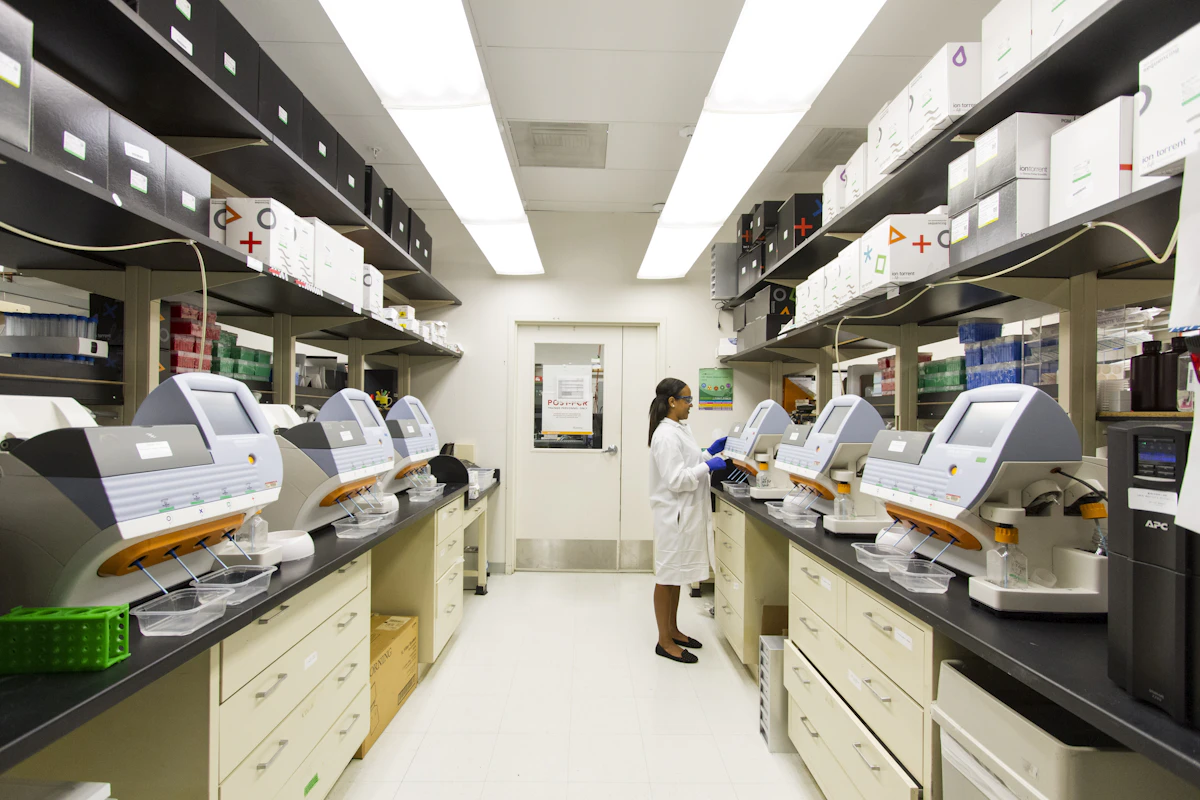
 Gene therapy trials involve specialized laboratory techniques not found in conventional drug trials, including DNA analysis and vector manufacturing. Photo: Wikimedia Commons (CC BY-SA 3.0)
The Timeline: How Long Does All of This Take?
The full journey from preclinical research to FDA approval typically spans 10 to 15 years. Here is a rough breakdown:
| Stage | Typical Duration |
|---|---|
| Preclinical research | 3-6 years |
| Phase 1 | 1-2 years |
| Phase 2 | 2-3 years |
| Phase 3 | 2-4 years |
| FDA review | 6-12 months |
These timelines can overlap. Many companies begin planning Phase 2 while Phase 1 is still underway, and some trials combine Phase 1 and Phase 2 into a single study (Phase 1/2) to save time.
Accelerated Pathways
The FDA offers several programs that can significantly shorten the timeline for therapies addressing serious or unmet medical needs:
- Breakthrough Therapy Designation: Provides intensive FDA guidance and rolling review for therapies showing substantial improvement over existing treatments. Casgevy, the first CRISPR-based gene therapy approved in the U.S., received this designation.
- Accelerated Approval: Allows approval based on surrogate endpoints, with confirmatory studies required afterward.
- Priority Review: Shortens the FDA review timeline from 10 months to 6 months.
- Fast Track Designation: Enables rolling submission of the BLA/NDA, meaning the company can submit sections of the application as they are completed rather than waiting until all data is assembled.
These pathways have been particularly important for gene therapies. Zolgensma (onasemnogene abeparvovec), an AAV gene therapy for SMA, was approved in just over four months after BLA submission under priority review, based on data from a study of only 22 patients (FDA, 2019).
The Cost: $1-2 Billion Per Therapy
Developing a new therapy is staggeringly expensive. A landmark 2020 study published in the Journal of the American Medical Association estimated the median cost of bringing a new drug from the laboratory to market at $985 million, with some estimates ranging as high as $2.8 billion when accounting for the cost of capital and failed programs (Wouters et al., JAMA, 2020).
These costs are not distributed evenly across the development timeline. Phase 3 trials, with their thousands of patients and multi-year duration, account for the largest single expense. For gene therapies, manufacturing costs add another layer — producing clinical-grade AAV vectors or manufacturing patient-specific cell therapies (like CRISPR-edited stem cells) requires specialized facilities and rigorous quality controls that are far more expensive than producing conventional pills.
This cost reality is one reason why approved gene therapies carry high price tags. Zolgensma was priced at $2.1 million per patient at launch, and Casgevy carries a list price of $2.2 million. These prices reflect not just the cost of manufacturing a single dose, but the cumulative investment in the decade-plus development process that made the therapy possible.
Success Rates: The Honest Numbers
The overall probability that a therapy entering Phase 1 will eventually receive FDA approval is approximately 10% (BIO, Informa Pharma Intelligence, QLS Advisors, 2021). That means roughly 9 out of every 10 therapies that are first tested in humans never reach the market.
Here is how the attrition breaks down:
| Transition | Success Rate |
|---|---|
| Phase 1 to Phase 2 | ~66% |
| Phase 2 to Phase 3 | ~29% |
| Phase 3 to FDA submission | ~58% |
| FDA submission to approval | ~90% |
| Overall (Phase 1 to approval) | ~10% |
Data from BIO Clinical Development Success Rates report, 2021
Gene therapies have historically had somewhat higher success rates than the industry average, partly because they target diseases with high unmet need and clear biological mechanisms. However, gene therapy development carries its own risks, including immune responses to viral vectors, challenges with durable gene expression, and manufacturing complexities.
What Participating Means for You as a Patient
If you are considering enrolling in a clinical trial, here is what you should know about the practical realities:
Informed Consent
Before you enroll, the research team is legally and ethically required to explain everything about the trial to you — in language you can understand. This includes the purpose of the study, what treatments you might receive, all known risks and potential benefits, what alternative treatments are available, and your right to withdraw at any time without penalty. You will sign an informed consent form, but consent is not a one-time event. The research team should continue to inform you of any new findings throughout the trial.
Treatment Cost
In most clinical trials, the experimental therapy is provided at no cost to you. The sponsor (usually the pharmaceutical company) covers the cost of the therapy itself, as well as study-related tests and procedures. However, routine medical costs — visits to your regular doctor, treatments for conditions unrelated to the trial — are typically still billed to your insurance. Some trials also provide compensation for travel and lodging, particularly if the trial site is far from your home.
Monitoring and Follow-Up
Clinical trial participants are monitored more closely than typical patients. You will have frequent clinic visits, blood draws, imaging scans, and check-ins with the research team. For gene therapy trials, follow-up can extend for years or even decades after treatment. This intensive monitoring is designed to keep you safe, but it also requires a significant time commitment.
Your Rights
You can leave a clinical trial at any time, for any reason. You cannot be penalized for withdrawing. You have the right to ask questions and receive honest answers. An independent Institutional Review Board (IRB) — a committee that includes scientists, ethicists, and community members — reviews and approves every clinical trial before it begins to ensure that patient rights and safety are protected (U.S. Department of Health and Human Services, 2018).
The Emotional Dimension
Participating in a clinical trial can be deeply meaningful. Many patients describe feeling a sense of purpose — that by participating, they are contributing to something larger than themselves, potentially helping future patients even if the trial does not help them personally. But clinical trials can also be emotionally difficult. The uncertainty, the monitoring, the possibility of side effects, the chance that you might receive a placebo — all of these take a psychological toll. Having a strong support system and open communication with your medical team is essential.

The Bottom Line
Clinical trials are the bridge between scientific discovery and treatments that help real patients. They are rigorous, carefully regulated, and designed to protect the people who participate. The process is long — 10 to 15 years on average — and expensive, with roughly $1 to $2 billion invested per successful therapy. The odds are steep: only about 10% of therapies that enter Phase 1 testing ever reach FDA approval.
But for patients with serious or life-threatening diseases, especially genetic conditions that gene therapy can address, clinical trials represent something irreplaceable: access to treatments that do not yet exist anywhere else. If you are considering participating in a gene editing clinical trial, the next step is understanding how to find and evaluate the trials available to you. Our companion guide, CRISPR Clinical Trials: How to Find and Enroll in a Gene Editing Study, walks through that process in detail.
The clinical trial system is imperfect. It is slow, expensive, and not equally accessible to all patients. But it is also the reason that therapies like Casgevy, Zolgensma, and Luxturna exist — therapies that have changed lives in ways that would have seemed like science fiction a generation ago. Understanding how the system works is the first step toward navigating it with confidence.
Sources & Further Reading
- Biotechnology Innovation Organization (BIO). "Clinical Development Success Rates and Contributing Factors 2011-2020." (2021) — Comprehensive dataset on trial success rates across therapeutic areas.
- Wong, C.H., Siah, K.W., Lo, A.W. "Estimation of clinical trial success rates and related parameters." Biostatistics 20(2):273-286 (2019) — Statistical model for transition probabilities between clinical trial phases.
- Thomas, D.W. et al. "Clinical Development Success Rates 2006-2015." Clinical Pharmacology & Therapeutics 101(1):29-36 (2016) — Analysis of Phase 2 attrition and the "valley of death" in drug development.
- Hay, M. et al. "Clinical development success rates for investigational drugs." Nature Biotechnology 32:40-51 (2014) — Landmark study quantifying drug development attrition.
- Wouters, O.J., McKee, M., Luyten, J. "Estimated Research and Development Investment Needed to Bring a New Medicine to Market, 2009-2018." JAMA 323(9):844-853 (2020) — Updated cost estimates for drug development.
- U.S. Food and Drug Administration. "IND Application Process." FDA.gov (2023) — Official overview of the IND filing process.
- U.S. Food and Drug Administration. "Long Term Follow-Up After Administration of Human Gene Therapy Products: Guidance for Industry." (2020) — FDA guidance on post-treatment monitoring for gene therapies.
- U.S. Food and Drug Administration. "FDA Approves Innovative Gene Therapy to Treat Pediatric Patients with Spinal Muscular Atrophy." (2019) — Announcement of Zolgensma approval.
- U.S. Department of Health and Human Services. "Federal Policy for the Protection of Human Subjects (Common Rule)." 45 CFR Part 46 (2018) — Legal framework governing IRBs and patient protections in research.
- ClinicalTrials.gov — The U.S. government's registry and results database for clinical studies, maintained by the National Library of Medicine.
Last updated: November 2025.

