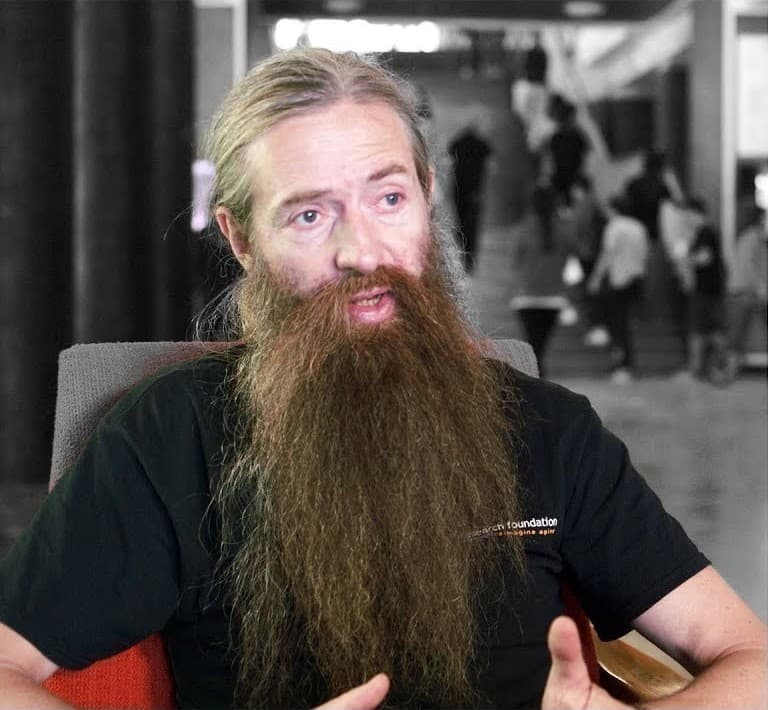
Few figures in longevity science have been as polarizing as Aubrey de Grey. With his distinctive beard, provocative public statements, and unwavering insistence that aging is an engineering problem with identifiable solutions, de Grey spent two decades as the most visible advocate for the idea that human beings need not grow old and die on the timeline that biology currently imposes. He co-founded influential organizations, delivered some of the most-watched TED talks on aging, and developed a theoretical framework that has shaped how an entire generation of scientists and entrepreneurs think about rejuvenation. He also became the subject of sexual harassment allegations that led to his departure from the organization he built. His story is a complex case study in visionary ambition, institutional influence, and the human frailties that can undermine both.
From Computer Science to Biogerontology
Aubrey David Nicholas Jasper de Grey was born in 1963 in London, England. He studied computer science at the University of Cambridge, graduating in 1985, and spent several years working in the field of artificial intelligence research at the university. His pivot to biology was unconventional: he became interested in aging through his marriage to Adelaide Carpenter, a geneticist at Cambridge, and began reading voraciously about the biology of senescence.
De Grey had no formal training in biology or medicine. He was, by his own description, an autodidact who approached aging as an engineering problem rather than a basic science question. In 2000, he earned a PhD from Cambridge for a thesis on mitochondrial mutations and aging, based on a book he had written rather than traditional laboratory research. This unusual academic path would become both a source of his distinctive perspective and a recurring target for his critics.
The SENS Framework
De Grey's most important intellectual contribution is SENS: Strategies for Engineered Negligible Senescence. First articulated in detail in the early 2000s, SENS is a framework that categorizes the damage of aging into seven distinct types and proposes specific repair strategies for each:
- Cell loss and tissue atrophy -- to be addressed through stem cell therapies and growth factor stimulation.
- Division-obsessed cells (cancer) -- to be combated through WILT (Whole-body Interdiction of Lengthening of Telomeres), a radical proposal to eliminate telomerase gene expression throughout the body and periodically replenish stem cells.
- Death-resistant cells (senescent cells) -- to be cleared using targeted senolytic drugs or immune therapies.
- Mitochondrial mutations -- to be bypassed by placing backup copies of mitochondrial genes in the nucleus (allotopic expression).
- Intracellular junk (lipofuscin and other aggregates) -- to be degraded using enzymes borrowed from soil bacteria and other organisms.
- Extracellular junk (amyloid and other aggregates) -- to be cleared through immune-based approaches.
- Extracellular crosslinks (tissue stiffening) -- to be broken using targeted chemical agents.
The SENS framework was deliberately comprehensive and deliberately provocative. De Grey argued that if all seven types of damage could be periodically repaired, the body could be maintained in a youthful state indefinitely. He was not claiming that each repair strategy was ready for clinical use, but rather that each category represented a defined engineering challenge with identifiable paths to solution.
Longevity Escape Velocity
Perhaps de Grey's most famous concept is Longevity Escape Velocity (LEV). The idea is elegantly simple: if medical technology can extend healthy human lifespan by even a few decades, that additional time provides the opportunity to benefit from further advances in rejuvenation medicine. At some point, the rate of medical progress outpaces the rate of biological aging, and life expectancy begins to increase by more than one year for every year that passes. At that point, people effectively stop aging -- not because a single magic bullet has been found, but because successive generations of therapies keep pushing the horizon further.
De Grey has argued that the first person to reach LEV may already be alive today, and that reaching LEV does not require perfecting rejuvenation -- merely achieving a "good enough" version that buys time for better versions to be developed. This concept has been enormously influential in framing longevity research as an urgent, achievable goal rather than a distant fantasy.
The Methuselah Foundation and SENS Research Foundation
In 2003, de Grey co-founded the Methuselah Foundation with David Gobel, initially focused on the Methuselah Mouse Prize -- an award for researchers who could extend the lifespan of laboratory mice. The prize generated publicity and attracted interest from researchers who might not otherwise have considered working on aging.
In 2009, de Grey founded the SENS Research Foundation (SRF), a nonprofit dedicated to funding and conducting research aligned with the SENS framework. Based in Mountain View, California, SRF funded research at universities worldwide, supported young scientists through internship programs, and organized annual conferences that became important meeting points for the longevity research community.
SRF's contributions to specific areas of research were meaningful. The foundation helped fund early work on senolytic drugs -- compounds that selectively kill senescent cells -- which has since become one of the most active areas of aging research, with multiple clinical trials underway. SRF also supported research on allotopic expression of mitochondrial genes, glucosepane crosslink breakers, and lysosomal enzyme therapies.
TED Talks and Public Advocacy
De Grey's public advocacy was relentless and effective. His 2005 TED talk, "A Roadmap to End Aging," has been viewed millions of times and remains one of the most influential presentations on longevity science ever delivered. In it, de Grey argued with characteristic bluntness that society's acceptance of aging as inevitable was not only scientifically unjustified but morally indefensible, given the scale of suffering it causes.
He appeared on countless podcasts, documentaries, and news programs, always making the same core argument: aging is the world's largest cause of suffering and death, it is caused by identifiable biological damage, and that damage can in principle be repaired. His book "Ending Aging" (2007), co-authored with Michael Rae, laid out the SENS framework in accessible detail for a general audience.
De Grey's public persona -- the long beard, the pints of beer, the unshakable optimism -- made him a recognizable and memorable figure. He was simultaneously embraced by longevity enthusiasts and criticized by mainstream gerontologists, many of whom considered his timelines unrealistically optimistic and his engineering-focused approach overly simplistic.
Scientific Criticism
The scientific establishment's response to SENS was mixed. A group of prominent biogerontologists published a critique in the EMBO Reports journal in 2005, arguing that several of the SENS proposals were speculative and not supported by sufficient evidence. De Grey responded vigorously, and the resulting debate raised the profile of aging research even as it highlighted genuine disagreements about the feasibility of specific interventions.
Over time, some of de Grey's ideas gained more traction. The senolytic field, which he championed early, has produced multiple candidate drugs now in clinical trials. The importance of mitochondrial dysfunction, extracellular matrix crosslinking, and cellular senescence in aging is now widely accepted. Whether SENS deserves credit for these advances or merely anticipated trends that were already emerging is a matter of ongoing debate.
Controversies and Departure
In 2021, de Grey's career took a sharp turn. Multiple women accused him of sexual harassment, including allegations of inappropriate behavior toward younger women affiliated with the SENS Research Foundation. An independent investigation commissioned by SRF substantiated several of the allegations. De Grey was removed from his positions at both SRF and the Methuselah Foundation.
The allegations and his departure were a significant blow to the organizations he had built and to the broader longevity movement he had championed. Some supporters attempted to separate de Grey's ideas from his personal conduct, while others argued that the incidents reflected deeper cultural problems within the longevity community.
Legacy and Influence
Aubrey de Grey's influence on longevity science is undeniable, even as his personal legacy is complicated. He was among the first public figures to articulate a coherent, comprehensive vision for treating aging as a medical condition. The SENS framework, Longevity Escape Velocity, and his tireless advocacy inspired thousands of researchers, entrepreneurs, and philanthropists to take aging seriously as a tractable problem.
Today, the longevity field is orders of magnitude larger than when de Grey began his advocacy. Companies like Altos Labs, Calico, Unity Biotechnology, and dozens of others are pursuing approaches that overlap significantly with the SENS framework. The scientific mainstream has largely accepted that aging is modifiable and that interventions targeting aging mechanisms could yield enormous health benefits.
Recent Developments (2025–2026)
De Grey now leads the Longevity Escape Velocity (LEV) Foundation, which he founded after departing SENS Research Foundation. In late 2024, LEVF completed its Robust Mouse Rejuvenation (RMR) Study 1, testing combination therapies targeting multiple SENS damage categories in middle-aged mice. The study extended mouse lifespans by four months through combination interventions — a meaningful result that demonstrates the principle of multi-target rejuvenation.
RMR Study 2 is expected to begin its main phase around mid-2026, with results anticipated in 2028. De Grey keynoted RAADfest 2025 in Las Vegas and spoke at the Longevity Summit Dublin, the International Longevity Summit in Madrid, and Aging Research & Drug Discovery in Copenhagen. He currently estimates a 50% chance of reaching longevity escape velocity by 2036, assuming adequate funding and regulatory agility.
Research Lab & Companies
- LEV Foundation — Founder and President (Robust Mouse Rejuvenation program)
- SENS Research Foundation — Former CSO and co-founder (departed 2021)
- Methuselah Foundation — Co-founder
- Active on X/Twitter: @auaborey
De Grey's story serves as a reminder that visionary ideas can reshape an entire field of science -- and that the personal conduct of the people who champion those ideas matters profoundly. The movement he helped build has grown far beyond any single individual, and its ultimate success or failure will be determined in laboratories and clinics, not by the reputation of its most famous advocate.


